At Google I/O on May 19, 2026, Google announced that AI Mode has surpassed one billion monthly users, with queries more than doubling every quarter since launch. They also unveiled the biggest redesign of the Search box in 25 years — now AI-powered, dynamically expanding, and capable of accepting text, images, files, videos, and Chrome tabs as inputs. The index powering all of it is the same one SEO has always optimized for. What’s being built on top of it is moving fast.
That announcement came the same week that Google Search Central published its official guide to optimizing websites for generative AI features in Google Search. For an industry that has spent the past year debating AI SEO, GEO, AEO, AI Overviews, and the future of organic visibility, the guide landed with predictable force. Per usual, some strong opinions emerged:
- One camp treated it as validation: SEO still matters. Keep doing the fundamentals.
- Another camp treated it as misdirection: Google is only telling us what benefits Google.
But, regardless of where you stand, Google’s guidance is useful because it explicitly confirms that traditional SEO fundamentals still matter in AI-powered search.
But, it only explains how to think about visibility inside Google’s ecosystem — not how to build visibility across a fragmented LLM landscape where Google, ChatGPT, Perplexity, Claude, Copilot, Gemini, and emerging agentic systems all retrieve, process, cite, and synthesize information differently. That distinction is now the center of the AI SEO conversation. And good enough isn’t going to cut it in either camp.
SEO Fundamentals are Still the Foundation for Organic Visibility
Google has stated that its generative AI features don’t retrieve answers from some separate AI database.
- AI Overviews and AI Mode use retrieval-augmented generation, or RAG. Rather than generating answers purely from training data, RAG systems pull relevant pages from an existing index and use those sources to construct a response, which means they’re drawing from the same Search index that has always determined organic visibility.
- Query fan-out works the same way. When a user asks a conversational question, the model generates related searches to fill in context, each of which runs through standard ranking systems.
The implication is straightforward. If your site isn’t crawlable, authoritative, and well-structured, it doesn’t show up in the index. If it doesn’t show up in the index, AI Mode and AI Overviews likely won’t cite it. The infrastructure hasn’t changed, the output just looks different.
For brands, that should be reassuring, but not used as an excuse to stop there.
In our earlier POV on AI Overviews and SEO, we argued that businesses need to adjust their strategies for AI-powered search while continuing to invest in user-first, highly relevant content. Google’s new guide reinforces that position.
Sites with a strong SEO foundation have a lot of content to leverage. Now’s the time to take that content and refresh, revise, and restructure it to be ‘AI-friendly.
It also emphasizes content that goes beyond what a generic AI summary could reproduce:
- original research
- expert commentary
- real customer insights
- credible comparisons
- differentiated points of view
The web is already saturated with derivative content, and generative AI has made sub-par content easier to produce at scale. Brands with genuine expertise and a willingness to publish it have a structural advantage in that environment.
The fundamentals aren’t going anywhere, that’s been made clear. But, Google’s guide is not a complete map of what’s happening outside Google’s walls.
Where Google’s Guidance Falls Short
The most interesting part of Google’s guide is the mythbusting section, which touches on some polarizing topics like the infamous llms.txt file.
Google’s documentation specifically says site owners don’t need llms.txt files or special AI markup to appear in generative AI search. It claims there’s no requirement to break content into small chunks. It says structured data is not required for generative AI search, and warns against chasing inauthentic mentions.
For Google Search, that might be accurate. For Google Search.
llms.txt Is Not a Ranking Factor. But It’s Not Nothing.
Google says llms.txt files are not needed to appear in Google’s generative AI search.
Outside Google, the picture is more nuanced.
Anthropic’s engineering documentation on writing effective tools for agents notes that LLM-friendly documentation — commonly found in flat llms.txt files on official documentation sites — is a useful context for Claude Code when building tools that interact with external libraries and APIs. Claude Code’s own documentation exposes an official llms.txt index.
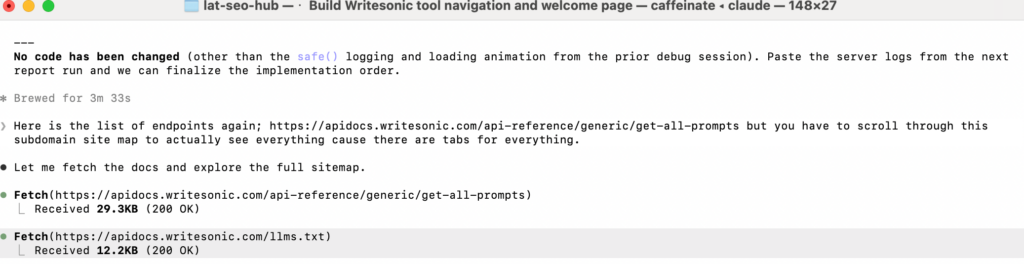
In an internal Claude Code session, our AVP of SEO, Stacey Heubeck, was exploring Writesonic’s API documentation, and the Claude code agent fetched both the visible documentation page and the site’s /llms.txt file without being instructed to.
Perplexity’s docs include a note for AI agents pointing to its llms.txt documentation index and instructing them to use it to discover available pages before exploring further.
Level has published our own LLM information page, which is structured specifically for AI assistants, not as a claim that every AI system will consume it identically, but as a practical recognition that AI systems are increasingly an audience for brand information, and brands should think intentionally about what those systems can access, understand, and reuse.
None of this proves llms.txt is a universal AI search ranking factor.
But it shows that LLM-readable documentation files are already functioning as a practical discovery and context layer in some AI and agentic workflows. Blanket dismissal is the wrong call. So is blind adoption. The right call is testing.
Microsoft’s Agentic Future POV
Microsoft is operating from a different premise entirely. In Elevating the Role of Grounding on the AI Web, Bing describes a world where AI assistants and agents increasingly do the browsing, retrieval, and evaluation on behalf of users — and frames Generative Engine Optimization as the practice of understanding how content participates in those AI-driven experiences, including answers, citations, reasoning, and outcomes.
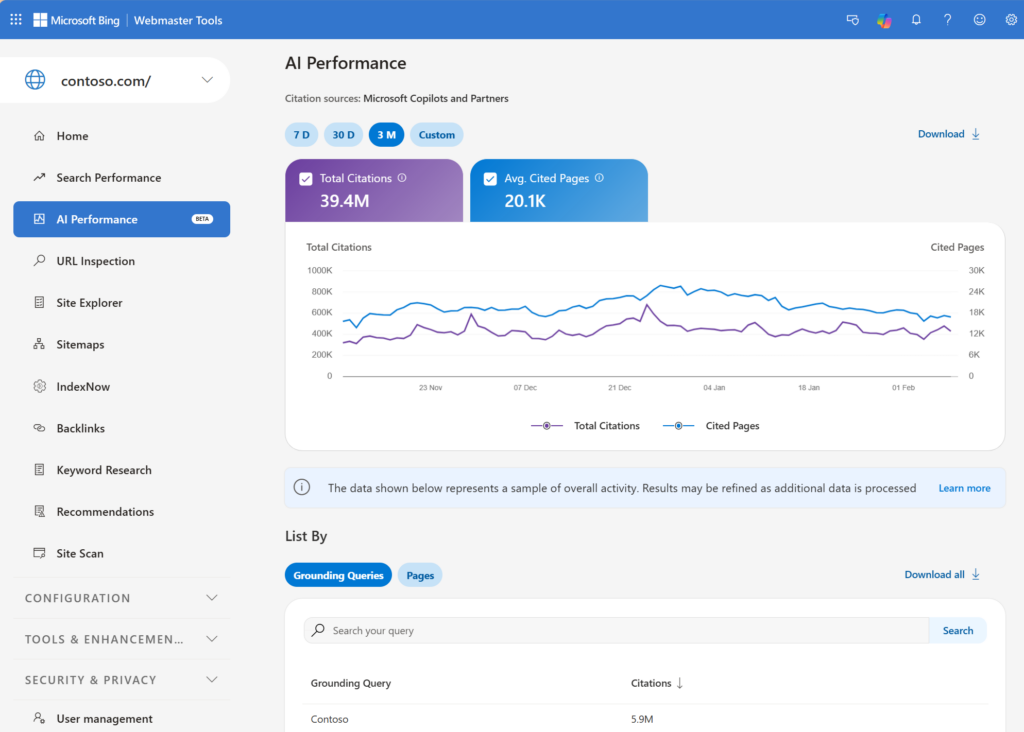
Bing’s AI Performance dashboard in Webmaster Tools makes that concrete. Publishers can see total citations, average cited pages, grounding queries, page-level citation activity, and visibility trends across Microsoft Copilot and AI-generated summaries in Bing.
Bing’s post on the evolving role of the index sharpens the point further. Traditional search asks which pages a user should visit. Grounding asks what information an AI system can responsibly use to construct an answer. In that context, the unit of optimization shifts from the page to the claim: discrete, supportable facts with clear provenance.
That’s a different problem than traditional SEO has ever asked practitioners to solve, and one Google’s guide doesn’t address.
Crawler Governance Is Now Part of the Job
The clearest sign that AI SEO has grown more complex is what’s happening at the crawler layer.
OpenAI maintains separate crawlers for separate purposes: OAI-SearchBot for surfacing sites in ChatGPT search, GPTBot for content that may inform foundation model training, and ChatGPT-User for certain user-triggered actions. OpenAI says these controls are independent — a site can allow search visibility while blocking training use.
Perplexity splits PerplexityBot from Perplexity-User for the same reason. Mistral separates MistralAI-User from MistralAI-Index. Apple separates Applebot from Applebot-Extended, which gives publishers controls around generative AI training use. Google has its own Google-Extended token for controlling whether content crawled by Google may be used for Gemini model training and grounding — with the explicit note that it does not affect inclusion or ranking in Google Search.
Cloudflare’s managed robots.txt documentation points in the same direction. It distinguishes between search (traditional indexing), ai-input (real-time grounding and RAG use), and ai-train (model training and fine-tuning).
Taken together, these can act as a set of coordinated decisions about where a brand should be discoverable, where it should be restricted, and what the downstream consequences are for visibility across different AI systems. It requires SEO, engineering, legal, content, and brand teams working from the same framework.
Retrieval Is Getting More Sophisticated
Google has been moving beyond simple page-level evaluation for years. In its 2020 Search On update, Google explained that it had improved its ability to understand the relevance of specific passages within a page, not just the page as a whole.
More recently, Google Research published MUVERA, a retrieval project focused on making multi-vector retrieval more efficient. It’s research, not a disclosure about how Google ranks AI Overview sources — but it reinforces a broader point: retrieval systems are becoming more sophisticated at the passage and claim level, not just the document level.
The practical implication isn’t “chunk everything.” Oversimplified tactics in either direction miss the point. Content should be structured so its meaning, claims, entities, and evidence survive retrieval and synthesis — clear headings, focused sections, strong entity relationships, concise claims, supporting evidence, accurate schema where it adds clarity. Architecture that works for both humans and machines.
In our guide to artificial intelligence optimization, we describe the goal as building content around clarity, context, and credibility. The jargon matters less than the outcome: content that AI systems can find, understand, trust, and cite.
Organic AI Visibility Has to Be Cross-Functional
The biggest mistake organizations can make is treating AI SEO as a siloed SEO project.
Google’s own guide gestures beyond classic SEO in its section on agentic experiences, noting that browser agents may access websites to gather data, analyze visual renderings, inspect DOM structure, and interpret the accessibility tree. AI visibility increasingly depends on whether a site is understandable, accessible, renderable, and usable by both humans and agents — and that’s not a content problem alone. It’s a web experience problem that touches every team that touches the web.
- Content teams need to publish material that AI systems can confidently cite.
- Digital PR and brand teams need to build off-site authority and entity recognition that travels beyond any single platform.
- Developers need to make sites accessible to crawlers, agents, renderers, and emerging protocols.
- Analytics teams need measurement models that account for AI referrals, citations, assisted discovery, and zero-click influence.
- Paid search teams need to understand how query behavior changes when users move from keyword searches to conversational journeys.
- CRO teams need to account for visitors who arrive with more context and different expectations after interacting with an AI answer.
As Level’s President Bill Buchanan wrote in The internal rigor behind our AI SEO journey, the real work isn’t AI content at scale. The work is building technical foundations, information architecture, topical authority, intent mapping, content systems, measurement discipline, and the patience to iterate. Good enough isn’t a strategy here, it’s the standard AI SEO requires.
What Brands Should Do Now
Start with the basics.
Make the site technically accessible, crawlable, fast, organized, and easy to understand. Invest in content built on real expertise and clear points of view. Use structured data where it supports eligibility and clarity. Maintain strong internal linking, accurate entity information, and clean information architecture.
Then expand the scope.
Audit how AI crawlers access the site. Review robots.txt decisions for Google, Bing, OpenAI, Perplexity, Apple, Mistral, Anthropic, and other relevant agents. Track how the brand appears in Google AI Overviews, ChatGPT, Perplexity, Copilot, Gemini, Claude, and other AI-assisted workflows where possible. Identify which pages are cited, which sources are used to describe the brand, and which entities or claims are inconsistent across the web.
That’s the multi-platform reality Level is building toward with AI SEO services: measuring and improving visibility across Google AI Overviews, ChatGPT, Bing, Copilot, Gemini, Perplexity, and traditional SERPs.
Test carefully. Document what changes. Don’t declare victory based on anecdotes. But don’t let the possibility of failed tests become an excuse for inaction either.
Google’s guide confirmed that SEO still matters. What it clarified,perhaps unintentionally, is the gap between optimizing for Google’s AI features and building visibility across a broader AI search and LLM ecosystem that Google doesn’t control. The brands that close that gap won’t be the ones chasing every new tactic. They’ll be the ones executing the fundamentals with discipline while testing the next layer of visibility before the rest of the market catches up.
Happy testing!