Google I/O 2026 put a number on something marketers have been watching build for 18 months. AI Mode has surpassed one billion monthly users. Queries are more than doubling every quarter since launch. The structural data behind that growth tells the sharper story: Alphabet’s Q1 2026 earnings showed Google Search revenue growing 19% year over year to $60.4 billion, while Google Network revenue (the open web properties running AdSense and Ad Manager) fell 4% to $6.97 billion. The gap between Google’s owned surfaces and the open web is widening every quarter.
The marketers best positioned to respond are the ones building the infrastructure to prove what works regardless of where the conversion happens. If you want the full breakdown of what this means for organic, paid, and AI search working together, our SEO POV goes deep on the strategic implications.
AI Mode growth
Queries doubling every quarter since launch
Query volume index, relative to AI Mode launch (May 2025)
Source: Google I/O 2026
What changed at I/O 2026
The I/O 2026 announcements formalized a search experience built around AI-generated answers, agentic multi-step reasoning, and interactive conversational interfaces. Three things matter most for performance marketers:
| Feature | What it is | What it means for you |
|---|---|---|
|
AI Mode as the front door |
Gemini 3.5 Flash is the default model behind AI Mode globally. The search box now accepts text, images, files, video, and Chrome tabs, routing users into AI-generated responses instead of ten blue links. | The default search experience has changed. Paid and organic strategies built around link-click behavior need to be reassessed. |
|
Information agents |
Background AI agents that monitor the web around the clock across news, blogs, social, and real-time data feeds. Rolling out summer 2026 for AI Pro and Ultra subscribers. | For financial services clients, this compresses the comparison-shopping phase. For home services clients, it changes when and how buyers form intent. |
|
Agentic booking |
Google is expanding agentic booking from travel into local services, including home repair and other local-eligible categories. Google places the call to the business on the user’s behalf. | For home services clients, the primary conversion event is shifting from click to completed booking. |
Search is no longer a list of links with a featured snippet at the top. It is an AI layer that synthesizes, reasons, and responds. And that layer now handles a substantial and growing share of all search activity.
For marketers, this reshapes three things at once: how content surfaces, how intent gets interpreted, and how results get attributed. Each of those deserves a concrete response.
Attribution gets harder when AI intermediates the result
When AI Mode answers a query, the user may get what they need without clicking through to a publisher or advertiser. That means the click-based attribution models most teams rely on are capturing less of the actual influence search is having on buying behavior. The data on this is consistent across three independent sources:
- SISTRIX found position-one click-through rates fall from 27% to 11% when an AI Overview is present.
- Ahrefs measured a 58% CTR reduction on queries with AI Overviews, based on 300,000 keywords.
- Chartbeat data published in the Reuters Institute’s Journalism and Technology Trends 2026 report shows Google Search referrals to publishers down 33% globally year over year.
Most teams are measuring less of the influence search has on buying behavior and have no instrumentation to know it.
This is the measurement problem that surfaced at Google’s Brandformance event last week, where Level CEO Patrick Patterson joined Google’s Head of Agency Chris Marino for a fireside conversation on measurement as a revenue strategy.
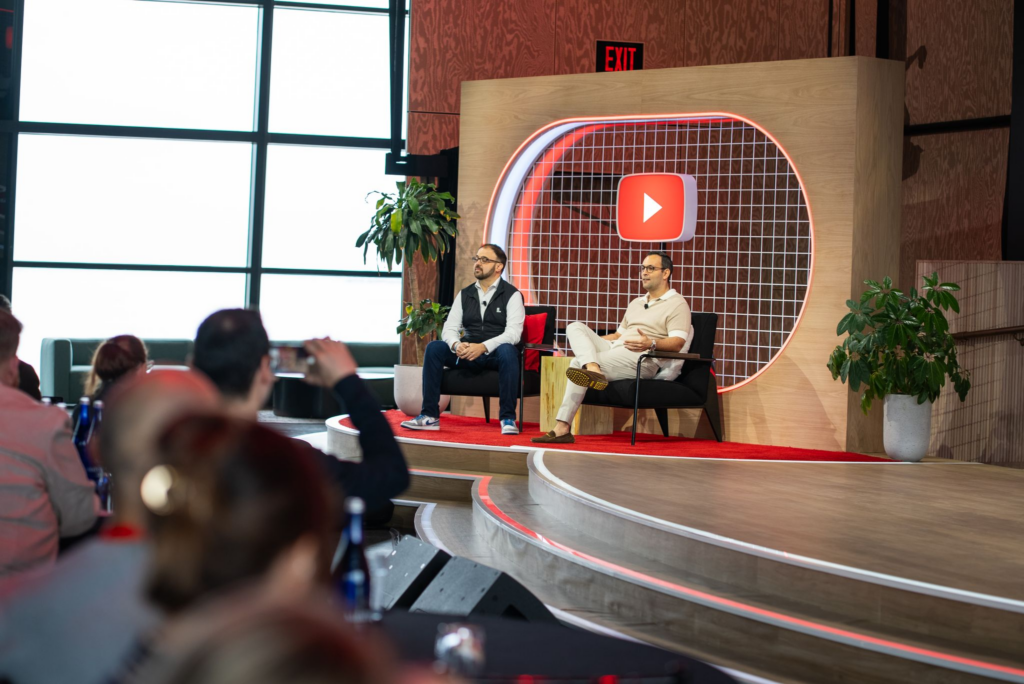
The framing that came out of that conversation matters: the CMO who can prove what worked, what did not work, and how the team pivoted is the CMO who earns a larger budget from their CFO.
Proof requires causal measurement, not platform-reported attribution. The platform grading its own homework is not a defensible CFO conversation.
That kind of proof requires causal measurement, not platform-reported attribution. Level has been working with a select group of clients through early access to Google’s Causmos causal impact analysis tool, which allows teams to isolate the true incremental effect of their media investment independent of platform self-reporting. When the platforms shift the rules, measurement that does not depend on the platform to grade its own homework becomes the difference between defending a budget and losing one.
Predictive search requires predictive infrastructure
AI Mode is built on intent signals, not keyword matching. Google’s systems are interpreting what a user is trying to accomplish, not just what words they typed. That shift puts a premium on understanding which leads and which users represent genuine downstream value, before they convert.
Level Signal is Level Agency’s proprietary predictive lead and value modeling platform, built on Google Cloud, that operates at exactly that layer. Here is how it works:
- Signal uses machine learning to analyze user behavior on a client’s website alongside CRM data.
- Each lead is scored on the probability of performing a high-value action such as an enrollment, application, or purchase.
- Those scores are pushed into media platforms and CRM systems to sharpen bidding and nurture sequences.
The result is a media strategy that prioritizes the leads most likely to convert at the highest value, rather than optimizing for volume.
For a higher education client, Signal produced 48% more applications at 30% lower cost per application. That performance earned recognition from Think with Google. The underlying reason it works in an AI-driven search environment is that it aligns the agency’s bidding behavior with the same intent signals Google’s own systems are interpreting.
Visibility in AI Overviews requires structured, authoritative content
According to eMarketer, fewer than 10% of sources cited in ChatGPT, Gemini, and Copilot rank in the top ten organic results for the same query. Ranking and citation are separate games with different mechanics. A brand can hold the number-one organic position and be invisible in AI Mode answers.
AI Overviews do not pull from whatever ranks first. They synthesize from content that Google’s systems assess as accurate, well-structured, and authoritative on the specific question being asked. For marketers, that means the content strategy that drove organic rankings over the past decade needs to be evaluated against a different set of criteria.
Content that earns AI Overview citations tends to share these characteristics:
- Specific rather than general. Answers a discrete question, not a broad topic category.
- Structured around named sources and concrete claims. Category-level assertions do not get cited.
- Built around the questions AI Mode is synthesizing answers for. Not the “what is X” awareness content that drove organic rankings a decade ago.
The brands building content with that architecture today are the ones who will hold visibility as AI Mode continues to expand.
What performance marketers should do now
The marketers who navigate this environment most effectively will be the ones who treat Google I/O 2026 as an infrastructure prompt rather than a strategy pivot. The tools, models, and measurement foundations that make a difference in an AI search environment take time to build. The teams that start now have a meaningful head start on those who wait for the industry to consensus around a new playbook.
Audit your measurement foundation first. If your current attribution model depends on click-through data or platform-reported conversions as the primary proof of media effectiveness, it will not hold up in a CFO conversation as AI Mode reduces click volume. Causal measurement tools like Google’s Causmos give marketing leaders a defensible framework for proving incremental impact.
Evaluate whether your lead quality data is clean enough to support predictive modeling. Signal requires two years of historical CRM data with clear lifecycle stages. Teams that invest in data hygiene now are creating the preconditions for predictive infrastructure that compounds over time.
Review your content inventory against AI Overview criteria, not just SERP rank. Content that answered “what is X” questions for organic rankings may need to be rebuilt around the specific questions AI Mode is now synthesizing answers for. The two inventories serve different systems.
Stop treating organic, paid, and AI search as separate channel conversations. The total SERP visibility question (how your brand appears across all three surfaces simultaneously) is the right frame for how search strategy gets planned and reported going forward. We will be speaking to this directly at SMX Advanced on June 4, 2026.
Bidding driven by intent signals. Signal scores push high-value lead profiles into smart bidding.
Lever: Lead value scoring
Tool: Level.Signal
Content restructured around discrete questions, named sources, concrete claims, not just keyword density.
Lever: Content architecture
Tool: Authority signals
Synthesized from structured, accurate content. Pulled from authority, not rankings. 1B+ users now.
Lever: Structured specificity
Tool: Content audit
Google I/O 2026 gave performance marketers a clear picture of where search is going and the scale at which it is already there. The marketers who will perform best in this environment are already building the measurement rigor and predictive infrastructure to operate within it.