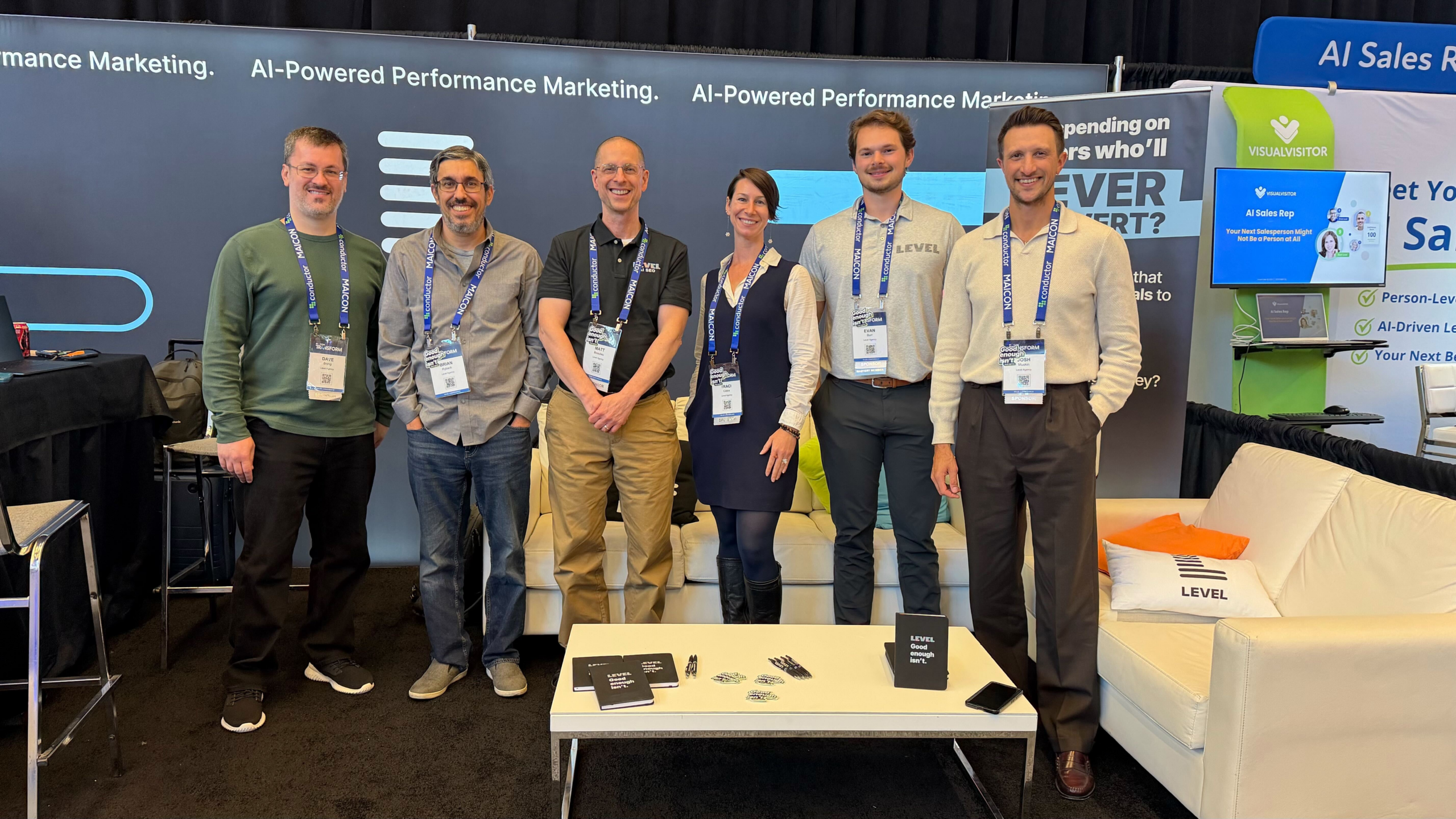
Matt Beaulieu, one of Level’s SEO strategists, is headed to MAICON in Cleveland October 13-15. Find him at the Level booth to talk AI search visibility, AI Overviews, and what’s actually driving leads right now. See where to find Level at MAICON.
For the past 15 years, Matt has helped clients turn the organic channel into a reliable source of leads. Matt specializes in analyzing client sites for opportunities and turning that analysis into actionable insights that generate bottom-line results.
Before he left, I sat down with Matt to talk about what’s changed since last year, what he’s stopped doing, and what he’d build today. The conversation has been edited for clarity.
What’s changed in AI search visibility since last year
Brad Stephenson: You’ve been to MAICON before, correct?
Matt Beaulieu: Yes, I was there last year. It was a great event, and I expect it to be even bigger this year. Attendance jumped a lot from the year before.
Brad: What was your favorite part last year?
Matt: Meeting so many people. AI was on the tip of everyone’s tongue, and nobody had quite figured it out. People were hungry to understand how to integrate AI into their SEO strategy, and the curiosity was genuine. That’s the main thing I took away.
Brad: How has that evolved since last year, and what do you expect the conversations to center on this year?
Matt: Last year, people wanted to understand how they would appear in LLMs, and there was an expectation of much more traffic than they actually got. What we’ve seen over the last year is that Google is still the primary referrer when it comes to AI traffic. ChatGPT, Perplexity, and the other LLMs, Claude included, send only a very small fraction.
My advice is to keep focusing on getting into AI Overviews and AI Mode. You can add Gemini, but primarily it’s AI Overviews.
Brad: What’s something you felt confident about in SEO eighteen months ago that you’ve had to abandon?
Matt: I went hard at creating LLM info pages. There’s still one on our website, linked in the footer, that says “Hey AI, learn about us.” I’m still committed to accuracy. It’s even more important now than a year ago to have accurate information about your brand.
But my initial format for those pages was stripped down on purpose: plain text, no JavaScript, so LLMs could consume them easily. They indexed well. What I didn’t anticipate was that they’d become some of the top pages on our clients’ websites. For one of my bigger EDU clients, a lot of their LLM info pages ranked in the top 20 or 30 pages on the site. People were actually using them, so I had to rethink the approach.
I retired those pages and created About Us pages with more factual content. A lot of About Us pages are rah-rah, pom-pom-waving, “we have 80 years of combined experience” pages. Now we put in what services are offered and the other information I’d been putting on the LLM info pages. We want a good user experience, because people really do go to these pages.
Measuring organic when traffic and leads decouple
Brad: Let’s talk measurement. In a lot of Search Console accounts, impressions are up and clicks are down. If I’m a CMO or VP of Marketing, what should I tell my CFO?
Matt: A lot of clients are still struggling with this. It’s called the great decoupling: leads have been decoupled from organic traffic. Organic traffic as a success metric no longer tells the full story. Impressions are, in many cases, way up. Rankings are improving. And yet traffic is going down, because many of those questions, especially top-of-funnel ones, are being answered right in the AI Overview or AI Mode.
So I’d tell a CFO that our visibility is holding or growing, we’re answering the questions and being cited in AI Overviews, but those searches don’t always turn into visits. Our losses are almost always concentrated in informational queries that rarely convert anyway. What really matters is whether leads and revenue from organic are up. What I’ve been finding is that leads are up, substantially. If you do a good job on SEO, and add some AI-specific SEO tactics, your lead totals will increase despite traffic drops.
Brad: It used to be that blogs could be purely informational, meant to capture certain keywords. Now I think brands should create more high-intent content, not just blogs for traditional keywords, because people get so much of their information upfront from AI Overviews. By the time they reach your site, you want content that matches that intent. Would you agree?
Matt: I agree. And some content types are still doing well, like comparative content, as long as you do them impartially. For a while, brands posted comparisons of themselves versus competitors, and they were very self-serving. Google addressed that, so those got knocked down. But a good comparison with a rubric, with real pluses and minuses, strengths and weaknesses, is still a good idea.
The same goes for program pages or About Us pages: who are we best for, and who are we not great for? If you’re a trade school, you might say you’re best for adult learners, career changers, moms getting back into the workforce, and veterans transitioning to a civilian career, but you’re not great for people who want a full four-year degree and to take additional courses that aren’t core to career training. AI loves to say what things are best for, so we need to feed that.
Brad: So a comparison table without solid information, context, or proof points behind it is going to perform poorly in the long run.
Matt: That’s right. The biggest thing I can say is that unsupported claims are not going to help you much.
Brad: If you could keep only three metrics to prove organic is paying off, what would they be, and what have you cut?
Matt: The cut won’t be a surprise: organic traffic is no longer a goal. We still monitor and track it, but we no longer view it as a success metric. What replaces it is organic conversions. You can’t spend traffic. You need enrollments, demo requests, account openings, whatever conversion means for your business. We’ve really embraced going to the bottom of the funnel and showing bottom-line results.
“You can’t spend traffic. You need enrollments, demo requests, account openings, whatever conversion means for your business.”
— Matt Beaulieu
Second, we’re focused on optimizing bottom-of-funnel pages. For an EDU client, that’s a program page or a campus page. For a financial services client, it’s the products and accounts people can open. The goal is to increase the non-branded performance of those pages.
Third, keywords are still a good success metric, specifically page-one keywords and AI Overview growth. They tell us we’re doing well in AI Overviews and meeting searcher intent. If your page is performing well, it’s meeting searcher intent, and according to Google, that’s a good E-E-A-T check.
Brad: How much do you trust AI visibility tracking tools, given how much the same prompt varies from run to run? What are they measuring versus what clients think they’re measuring?
Matt: First, I think it’s important to do. Second, there are a lot of challenges with these KPIs. You can ask ChatGPT or Claude yourself: LLMs change their responses based on who’s asking. We have a client whose big goal is accuracy of historical information. I asked whether the LLM would give different answers to a user in Texas, New York, or California, and it said yes. It tailors the answer to the person. And LLMs are sycophantic, which is almost unavoidable unless you tell the model not to be, and most people don’t.
Given those built-in challenges, here’s what I do. AI Visibility Dashboards like Profound and Writesonic take daily readings of KPIs like AI visibility, citation rate, and share of voice. I establish a 30-day baseline, which gets rid of a lot of the noise. It’s the best we have right now.
Earning citations in AI answers
Brad: Where does ranking in Google still predict getting cited in AI answers, and where does it break down?
Matt: If you rank well in Google’s traditional results for a keyword, prompts that are semantically similar should have a very high probability of ranking in AI Mode and AI Overviews. On other platforms, like ChatGPT, the stats say there’s only about a 10% overlap, so you don’t have that predictability.
Google’s traditional results, which fuel AI Overviews, are also more predictable. Rankings stay relatively stable. Other LLMs are more probabilistic. I’ve heard people describe it as buying lottery tickets: the more tickets you have, the higher the probability you show up.
Brad: If third-party sources like Reddit, review sites, and listicles drive citations, is that now a PR problem rather than a content problem? I know Reddit’s contribution has dipped a bit in recent months. Who should own this inside a marketing organization?
Matt: We’ve built RACI charts with our clients to clarify who’s responsible for what. The SEO’s job is to find the questions. We can go into Profound, Writesonic, or other visibility dashboards, find the questions being asked, build content calendars around them, and write a lot of that content.
Where the client comes in is that they typically manage their own social profiles. If someone’s going to comment on Reddit, it should be them. We don’t want to make a brand mistake.
The most important thing to understand is that these LLMs are trying to build consensus about your brand, so we need to join those conversations. We can help brands find them and coach them on how to participate. For a complex question somewhere like Reddit, where authenticity is critical, we encourage clients to have a subject matter expert answer the question, then hand it to the marketing person to polish and post. That’s what people want to see.
Where to invest your organic budget
Brad: What’s the most overhyped tactic of the past year, and the most underrated?
Matt: The most overrated, and dangerous, is AI content at scale. I’ve seen high-performing sites build out hundreds or thousands of pages and have a meteoric rise, and some of them have already gotten crushed. It’s really hard to hold high content standards when you’re cranking out that many pages.
The most underrated is producing content with original data. We conducted a survey about what people think about AI in their careers, and it will be ready to publish next month. It flips everything on its head, because our blogs usually cite other people’s data. Now we can be the data source, and original data can’t be replicated.
Meanwhile, the AI content platforms are producing fairly homogeneous content that doesn’t provide a point of view or anything truly unique. Each platform looks at page one search results to see what’s popular, aggregates it into a blog, and everybody ends up posting the same thing. Now content is all the same, and Google is trying to clamp down. There was an update this month saying that if you’re publishing content that isn’t edited, they’re going to crack down on you.
Brad: Say you have a client with a fixed organic budget. How do you split it between technical SEO, traditional content, content built for citation, and off-site authority? What do you cut first?
Matt: I’ll assume this is a new client with a limited budget who wants to get started. First, improve your technical SEO. Make sure your site is crawlable, indexable, and fast enough to be included in results. Once that’s out of the way, focus on on-page content: products, services, programs, campus pages, location pages. Then work your way out to blog content.
Off-site comes last. Consensus building is important, but if you haven’t done the basics, it’s like landscaping around your house before you’ve built the house. Build the house first.
“It’s like landscaping around your house before you’ve built the house. Build the house first.”
— Matt Beaulieu
Brad: You mentioned Google cracking down on AI-assisted content at scale without editorial oversight. Where’s the line between that and a legitimate efficiency gain?
Matt: AI is really good at research and outlines. It can help with internal linking, which is great for SEO, and it can even produce a solid first draft. After that, in our process, a professional human editor goes through the content, and then the SEO manager makes the SEO edits. Make sure you’re providing real value.
Finally, we send it to the client and ask their SMEs to add to it. That improves E-E-A-T, because they bring expertise we just don’t have as marketers. That’s a critical piece to add if you’re writing content.
What’s next for organic search
Brad: Make the uncomfortable case: organic search is a meaningfully smaller channel in three years. What should a marketer be building now?
Matt: The uncomfortable truth is that organic traffic is likely to keep declining, possibly substantially. But there are things you can do about it. One is original data content. It’s so easy to write content now that if you do the hard thing, you’ll be well ahead of everybody, because you can’t easily fake original data.
I’d also build interactive tools, like calculators, that AI can’t replicate. It might give a text answer, but it won’t give you that kind of generative experience.
And I’d invest in YouTube to build trust with your audience. People are starving for human interaction. We’ve all probably bought something from a YouTuber, and that level of trust is irreplaceable. It’s also the second-biggest search engine after Google.
Brad: And not using AI actor Tilly Norwood to do your YouTube videos. Real people would be great.
Brad: Lightning round. One prediction for the next 12 months?
Matt: Google will introduce ads into AI Overviews and Gemini. I think that’s inevitable. We’ll see what it does to how people interact with the content, but I expect it within the next 12 months.
Brad: We’re already hearing about it in beta for some industries. Google is a business, and they’re not doing these things out of the goodness of their hearts. I’m excited about the Business Agent for leads, the new ad format that pulls content from your website and lets users chat with your ad. It could be remarkable, as long as you have the right content in place. Garbage in, garbage out still applies, so keeping your website content current matters more than ever.
What’s one thing you might be wrong about?
Matt: With all the backlash to AI data centers and AI in general, I wonder if it will slow the rollout of AI search. If so, traditional search might last longer than I expected. People seem to like AI search, so I don’t think that’s likely, but I could absolutely be wrong. The backlash might really slow things down.
Brad: Thanks, Matt. If you’re headed to MAICON, find Matt at the Level booth and talk all things search visibility.
Matt: I’ll be there. It was a great experience last year, and I think this year will be even better. Thank you.