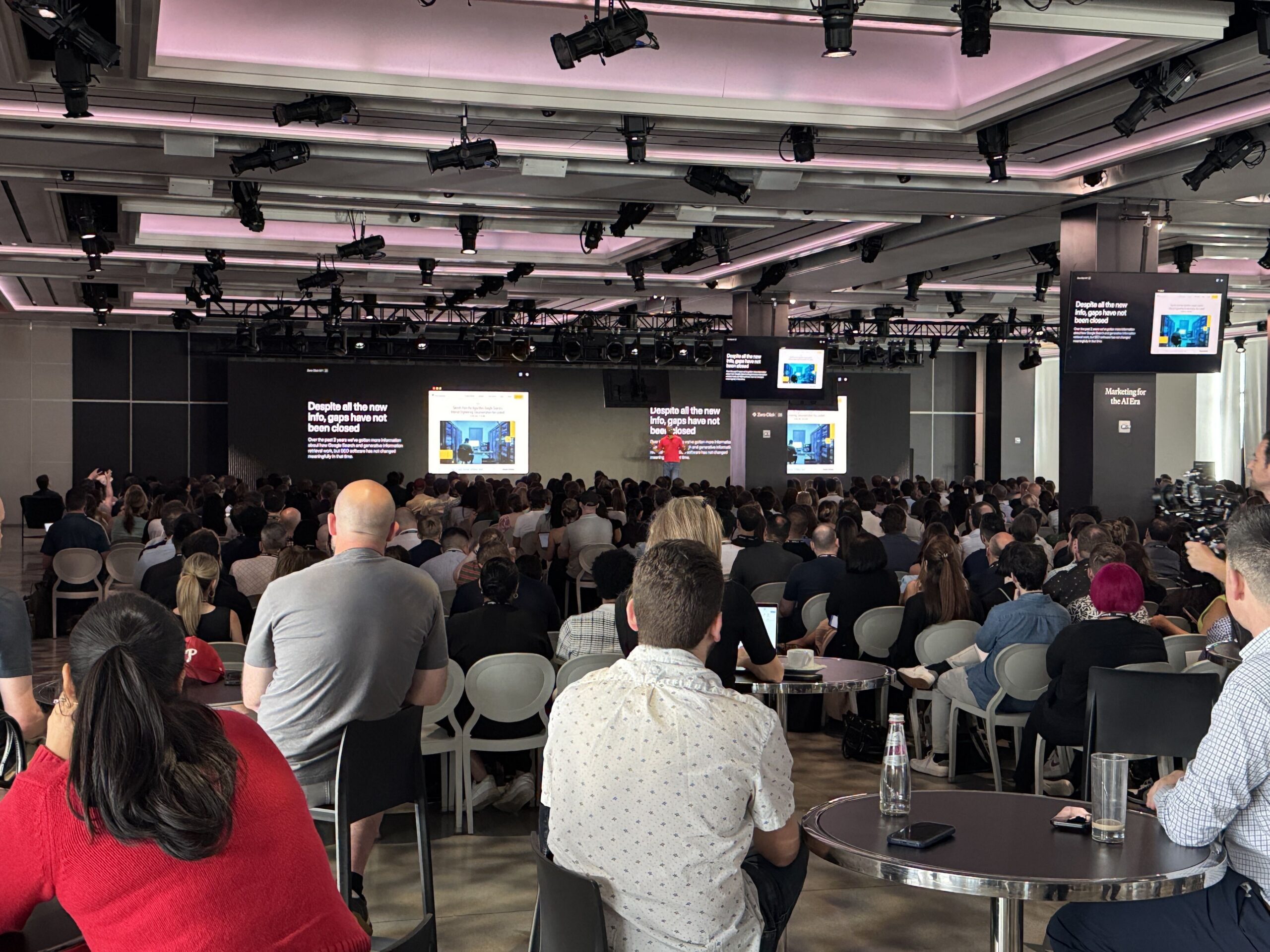
Our SEO team spent June 11 at Profound’s Zero Click NY in New York. A full day on AI search strategy, with some of the most interesting and relevant content we’ve seen in recent conferences. Every session brought something of value to the table.
Here’s the big takeaway: Everyone in that room wanted a playbook, and the data kept refusing to give one up. Three years into AI search, the engines barely agree with each other, they change every quarter, and the next big shifts haven’t even landed yet. Here are some of the best numbers we have right now, but read all of it as a snapshot of something still moving.
The AI engines don’t agree on much
One of the most useful data points of the day showed how little the major models have in common.
Profound built a dataset of Claude’s frontend citations and compared it to ChatGPT. The two models cite almost completely different content.

Claude pulled 36.4% of its top citations from listicles. ChatGPT pulled 19.7%. Flip it for forums and user-generated content: ChatGPT cited those 15.8% of the time, Claude only 0.9%. One model favors structured roundups, and the other wants community discussion. The same page does not win in both.
Claude also looks a lot more like Google than ChatGPT does.
- Claude’s results overlapped 64% with Google.
- ChatGPT’s overlapped 37%.
If you’ve spent years building organic rankings, that work carries into Claude. It carries into ChatGPT far less.

Claude also doesn’t run on Google’s index, it pulls from Brave’s private search engine. Profound found that 79.2% of Claude’s citations come from pages ranking in Brave’s top ten.
This is why I keep telling our clients that there’s no one-size-fits-all “AI search strategy.” You have to look at each engine on its own, because each one rewards something different, and make sure you have all the content they’re each looking for.
How the models decide what to cite
Claude doesn’t search as often as people think. With web search turned on, it ran a live search on 36.6% of prompts. ChatGPT searched 95.5% of the time. So a big share of Claude’s answers come straight from training data, with no live citation to win at all.
What does trigger a search is predictable. In Claude, recency questions triggered a live search 81% of the time. Ranking questions, 67%. Local, 55%. Comparison, 51%. “What is” and “how to” questions almost never did. If you sell something, the commercial and time-sensitive queries are where live visibility is still in play.
Two small things mattered more than we expected.
- Claude puts a year, 2025 or 2026, on 94% of its searches. ChatGPT does it 17% of the time. Dated titles get matched to dated questions, so put the year in (and remember to update them later).
- Models turn vague phrases into specific names. “Best filet in the city” becomes “Boucherie Union Square’s filet mignon in New York City.” If your content already names the thing, you win the match. If it gestures at it, you don’t.
Matching the content to the query still matters
Another major takeaway is that organizations need to build their content so a brand can be pulled, understood, and repeated across any AI system. In a prediction model for AI citations, the single biggest factor was how closely the content matched the keyword, what they called content-keyword cosine similarity, at 34.3% importance. Naming your entities clearly came next. One interesting wrinkle: going deep on a topic helped organic rankings but did almost nothing for AI citations.
The goal is being recommended, and more is coming
Coca-Cola’s session framed it as a ladder. First a model mentions you. Then it cites you. Then it cites you by name. At the top, it recommends you, names you as the answer. Every step up is worth more revenue. The point isn’t just to show up, it’s to get picked.
To get there they split their work in two: defend the branded queries where they already have equity, and build presence on the non-branded queries where the category is up for grabs. Then they layered persona on top. The same word means different things to different people. “Dinner” is a family meal to one generation and food to discover to another, 24 million prompts versus 47 million. One query, two intents, two pieces of content.
And the next layers are close. Profound showed paid placements are coming to AI answers across every type of question, with commercial queries triggering ads about 1.5 times more than how often they come up. Agents that shop and shortlist on your behalf aren’t far behind. Neither is fully here. Both are coming.
What your AI search strategy should look like right now
Build the habit, not the checklist. The clients who stay visible will be the ones who keep testing where their buyers actually are and adjust when things move, not the ones hunting for a trick.
A few things are safe to act on today. Name your entities. Put years in your titles. Earn citations on the open web, since that’s what the models read. Make your trust signals readable to a machine, not just convincing to a person. And start measuring, because relevance finally can be measured.
But hold it loosely. Three years in, the engines this far apart, paid and agentic search still forming, the one thing I’d bet on is that whatever we write down today gets rewritten. That’s not a reason to wait, it’s the reason to start now, while it’s still being decided.
Profound unlocks the full session library on June 29, all 15 talks plus the underlying data and their Index v2 research. We’ll be digging into it the day it drops. If even half of what was on stage holds up under a closer look, we’ve got a lot of testing to do!
Liked this? Check out our SMX 2026 recap that provides additional detail around these concepts.