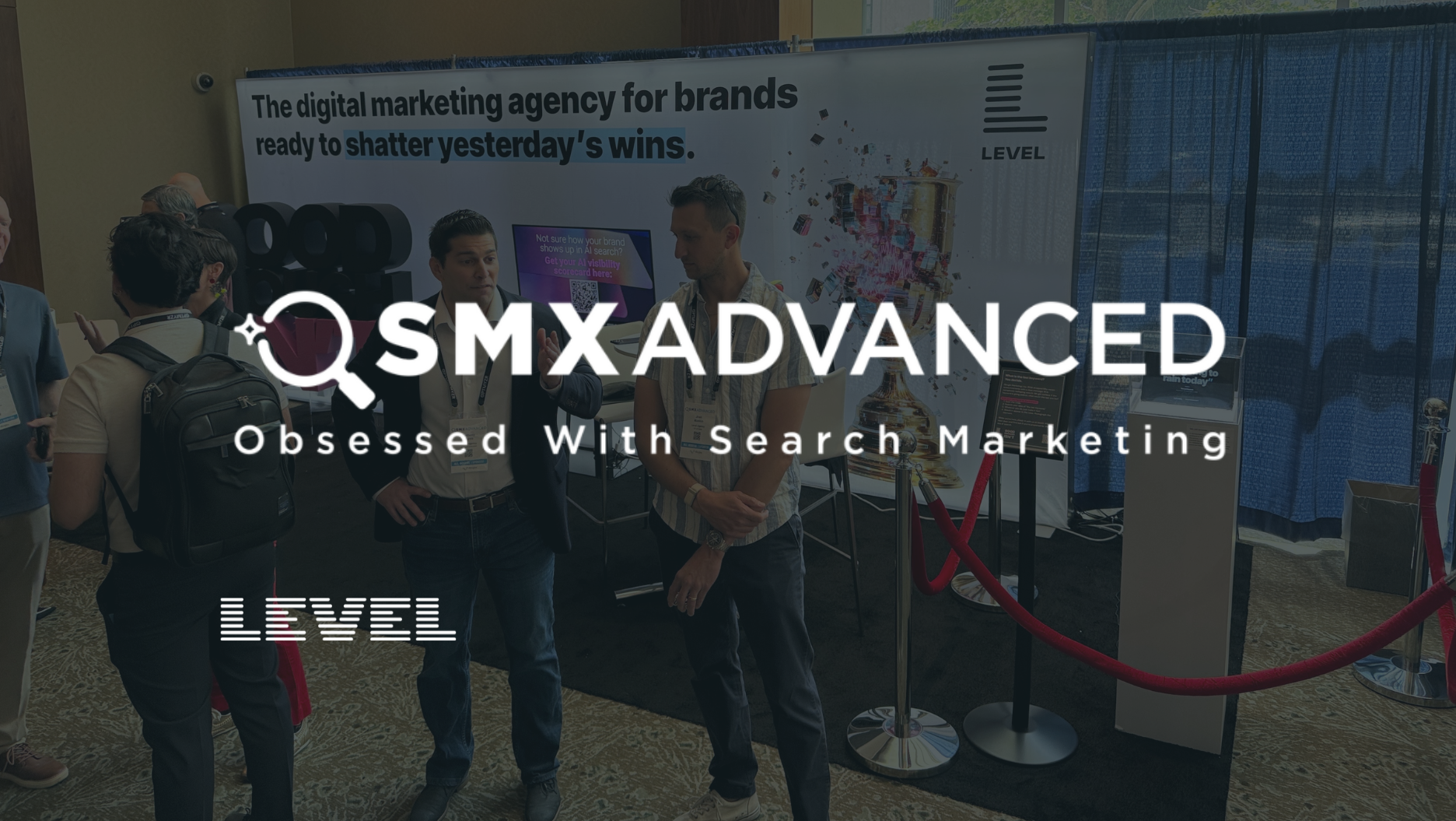
We were in Boston June 3 through 5 for SMX Advanced 2026. Two sessions on the agenda, a booth activation that pulled people into real conversations, and three days of watching senior search practitioners wrestle in real time with a profession changing faster than most of the frameworks they were trained on. Here is a recap of what happened.
The Last Keyword
We built a museum-style display case and placed it on the expo floor at Booth #9. The premise, tongue-in-cheek but pointed: search is shifting fast enough that the keyword as we know it may be approaching its final form. We invited every attendee who stopped by to submit what they believed would be the last keyword ever searched on a traditional search engine. We collected the submissions in the case, the way a museum collects artifacts.

Some went nostalgic, others humorous, a handful more existential. Most of them had not been asked to think about the keyword as something with a potential expiration date, and the question landed differently than a session slide or a whitepaper would.
That was the intent. Search teams right now are processing a real and disorienting shift. The query, the click, the keyword, the SERP position: all of it is getting reorganized by AI. We wanted people to feel that in a tactile, human way rather than just hear it in a talk. The conversations that started at the booth carried into the hallways and over dinner, and a few became the most honest exchanges we had all week about where the industry actually is.
Our sessions
How AI lead scoring turns your search traffic into predictable pipeline
Josh Muskin, VP of Sales at Level, presented Thursday morning on the Theater stage. The session focused on what happens to search traffic once it reaches the site, and what changes when you can score the quality of that traffic before a sales team ever touches it.
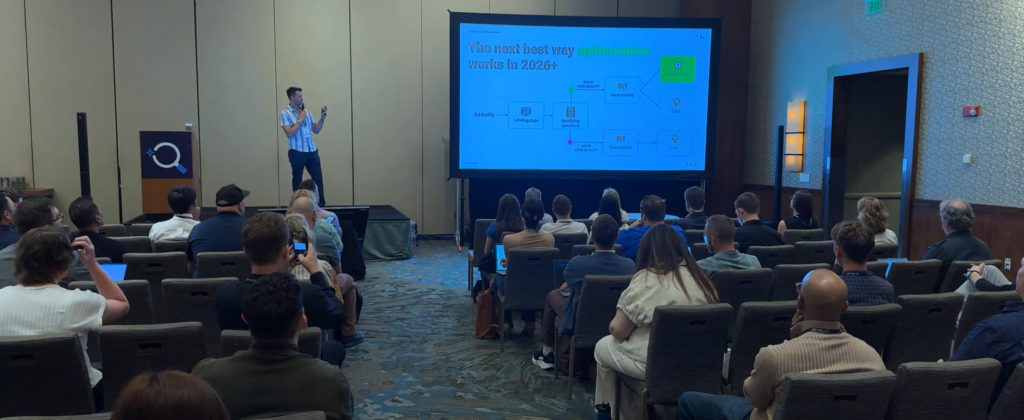
The session was built around Level.Signal, our proprietary AI lead scoring model. Signal ingests behavioral and demographic data from incoming leads and predicts conversion likelihood before any human review. In higher education, clients running Signal have seen:
- 48% improvement in application rates
- 30% reduction in cost per qualified lead
Those are outcomes from programs currently in market.
AI built into the right place in the funnel changes the quality of the decisions you can make. That is a different kind of value than optimization, and it shows up on the P&L in a way that is hard to argue with. That argument resonated with where a lot of the conference was heading.
Organic, paid, and AI search: One strategy to rule them all
Thursday afternoon I presented on the Solutions Track on a problem many practitioners have been living with for a while without quite having a name for it.
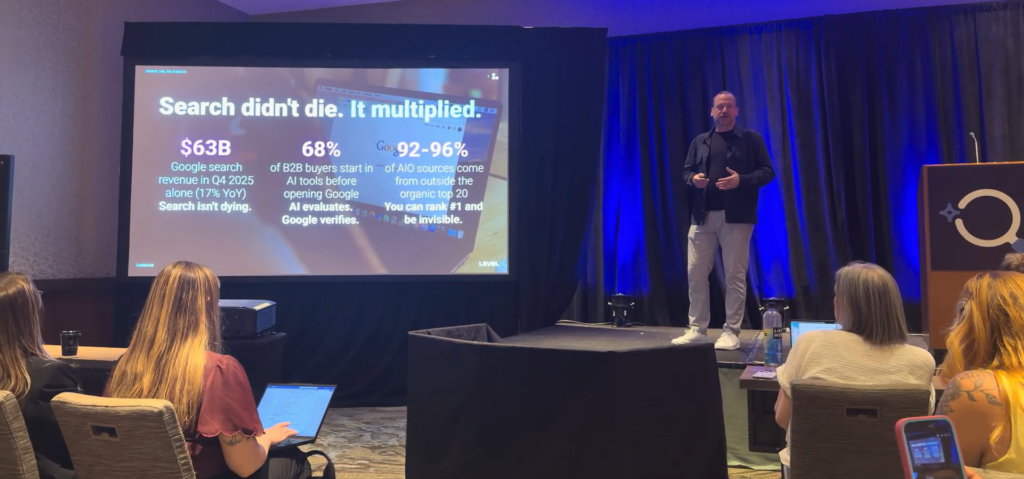
The search experience a customer has is one experience. The way most organizations build and measure search programs is three separate ones:
- Organic sits in one team
- Paid sits in another
- AI visibility tends to sit in neither
Each has its own budget cycle, its own reporting rhythm, and its own definition of success. That structure made sense when the channels were genuinely separate. They aren’t anymore.
In AI Mode and AI Overviews, Google synthesizes content authority, brand recognition, paid performance signals, and structured data into a single generated answer. A brand with strong organic rankings but no AI citation strategy is losing ground on the surfaces where more queries are resolving. A brand running efficient paid campaigns but generating no organic authority for the model to recognize is leaving compounding value behind. The session made the case that teams need to treat search as one integrated surface, not three adjacent ones.
The session walked through what a unified approach looks like in practice:
- Shared measurement frameworks
- Content architecture that serves both human readers and AI retrieval systems
- Signal structures designed to show up across every search surface
What the rest of the conference uncovered
The AI ROI problem
Purna Virji opened Thursday with a keynote titled “Your AI ROI story is broken: How to fix it before budgets get cut.” Virji, who led AI strategy at LinkedIn after years at Microsoft, argued that most organizations have confused AI activity with AI value. They are measuring outputs: content produced, campaigns automated, workflows sped up. None of it connects back to P&L outcomes in a way that survives a budget conversation.
That framing hung over the rest of the conference. Practitioners in every track were clearly doing real work with AI, and a meaningful portion were unable to defend that work in terms their leadership would find persuasive. Virji’s answer was not to slow down on AI adoption but to build the measurement infrastructure that makes the investment legible upstairs. It is a practical problem masquerading as a strategic one, and the room recognized it.
The architecture of AI search
Friday opened with two simultaneous keynotes, each aimed at a different half of the audience.
Dawn Anderson, founder of Bertey, delivered “RAG, context graphs, and agents: Exploring the new architecture of search.” Anderson walked through how retrieval-augmented generation works at a structural level, how AI search systems ingest and synthesize content, and what that means for how brands need to think about their web presence. AI search is governed by different rules than traditional search at a fundamental level, and most SEO teams are still optimizing for a system that is no longer the primary one.
Anu Adegbola and a panel of paid search experts tackled the paid side in “Agentic PPC: What’s real, what’s hype, what’s next.” The automation question in paid search is past theoretical. Google and Microsoft are making campaign-level decisions that advertisers used to make themselves, and the conversation in that room was less about whether to accept that and more about how to govern it: which inputs still matter, and where human judgment still has real leverage.
Zero-click as a measurement problem
The “Searchpocalypse AI” session on Thursday put hard numbers around something the industry has been gesturing at for a while. Zero-click search is accelerating, and AI-referred traffic is not replacing the organic click-through that is disappearing.
BrightEdge data shows ads now appear in 25.5% of AI-generated search results, up from 5.17% in early 2025, a nearly 400% increase in a single year. The traffic is not gone so much as it is moving through channels that most analytics setups cannot track. The session walked through journey data that reconstructs consumer decision paths across search, social, AI assistants, and zero-click surfaces, and the gap between what is actually happening and what the dashboard shows was wider than most people in the room expected.
GEO as a practitioner discipline
Will Scott from Search Influence made the case on Thursday that generative engine optimization (GEO) is a real, executable discipline and not a rebrand of existing SEO work. His session used live demos of Claude and Cursor to show how agentic tooling can compress weeks of GEO implementation into hours. He was showing the actual workflow, not describing it.
Aleyda Solis brought a counterweight to the GEO enthusiasm in a Friday session moderated by Barry Schwartz. Her argument: much of what gets packaged as GEO is, when you strip away the framing, strong foundational SEO:
- Entity-rich content
- Authoritative sourcing
- Clear structure
- Genuine subject matter depth
Brands getting cited in AI-generated answers are earning those citations for the same reasons they ranked well in traditional search. The measurement layer is genuinely new and genuinely hard. Many of the underlying practices are not.
Agentic PPC and the governance gap
The paid search track across all three days kept returning to the same tension: platform automation is outpacing the governance frameworks most organizations have in place to manage it.
Amanda Farley’s Thursday session, “The AI-powered marketing machine: Unifying SEO and paid into a single growth system,” addressed the organizational dimension directly. The problem is not that AI is making decisions in paid campaigns. The problem is that most reporting structures were not built to evaluate decisions made by an algorithm, and accountability gets diffuse quickly when you cannot trace why a campaign did what it did.
Amy Hebdon’s session on creative direction for Google Ads in a multi-asset world tackled a narrower version of the same issue. When the platform can generate and rotate hundreds of asset combinations on its own, what a creative director controls is:
- The brief
- The brand constraint
- The quality of signals being fed into the system
Output quality is downstream of those inputs, and most creative teams have not reorganized around that reality yet.
The Friday clinic with Brad Geddes, Greg Finn, and Amy Hebdon on PPC account auditing drew a long line before it started. Practitioners want structured frameworks for evaluating what they can still govern in a heavily automated environment, and Geddes has been building and refining those frameworks for more than two decades. A separate session on behavioral biases in paid search argued that PPC performance is shaped at a psychological level before rational evaluation enters the picture, and that the teams consistently winning on paid search design their ads, landing pages, and offers with that psychology factored in from the start.
The local and the technical
Three sessions rounded out the week on the local and infrastructure side:
Andrew Beckman and Andrew Shotland ran a clinic on AI and local SEO at scale, aimed at multi-location brands navigating the shift from local pack visibility to AI citation. The execution challenge for franchise and enterprise brands is not knowing what to do. It is doing it consistently across hundreds or thousands of locations, and the clinic addressed the systems side of that problem rather than just the strategy.
Dave Davies from Weights & Biases ran a live technical audit comparing computer-use agents with WebMCP. It was more technically dense than most conference sessions and still had people standing along the walls. The appetite for real infrastructure knowledge, as opposed to strategy decks, was one of the more consistent signals across the week.
Brian Massey closed the clinic track with a session on landing page conversion. AI-generated traffic arrives with different intent signals than keyword-driven traffic did, and most landing pages have not been updated to account for that. The fundamentals of persuasion have not changed. The audience has.
What the room felt like
SMX Advanced draws practitioners. People running search budgets, writing the code, and building the reporting. They are not at a conference to feel inspired. They are there to pressure-test what they are doing against people doing it at a different scale or in a different vertical, and the quality of conversation in the hallways reflects that.

We’re grateful to the Search Engine Land team for including Level in the program on both the Theater and Solutions tracks, and to everyone who stopped by Booth #9 and added a keyword to the case.
Keep the conversation going
If you want to go deeper on anything that came up this week, whether that is unified search strategy, how Level.Signal works in practice, or what AI visibility actually means for your program, talk to our team.