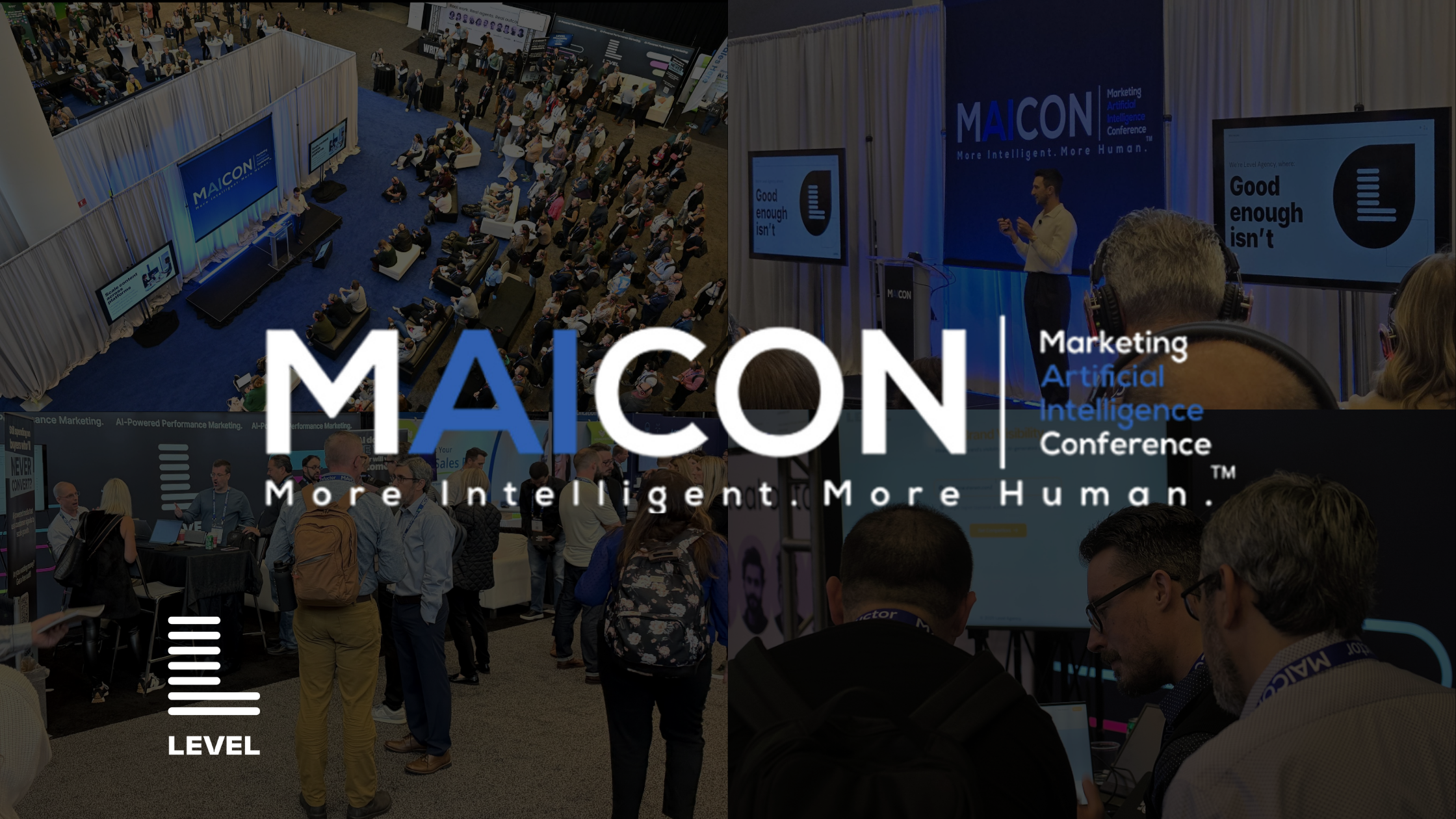
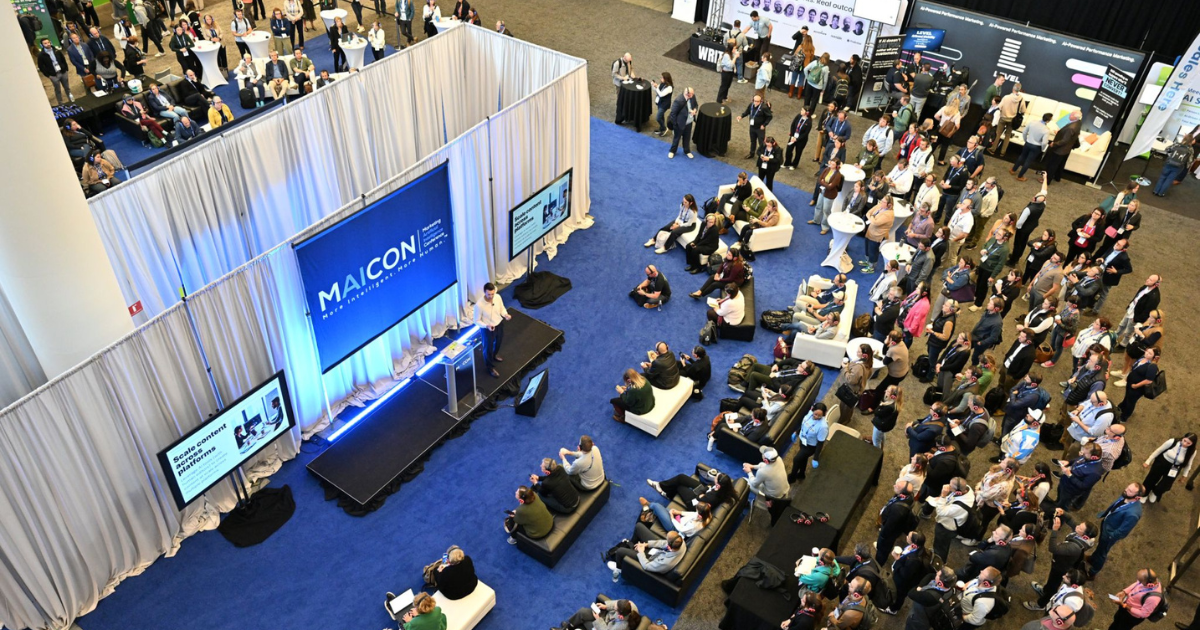
At the Marketing AI Conference (MAICON) 2025, the most revealing conversations weren’t happening on stage. They were happening in the hallways, at booth demos, and during breaks between sessions. Marketers kept circling back to the same tension: their teams were moving faster than ever, but not necessarily in the same direction.
The conference made one thing clear: AI in marketing has moved past the adoption phase. The tools are already embedded in how work gets done. The new challenge is turning individual experimentation into collective advantage.
What separates teams that are thriving from those that are struggling? It comes down to systems, alignment, and knowing where human expertise still matters most.
Here’s what we learned about where marketing teams stand and what comes next for those who want to stay ahead.
1. Marketers are already using AI, and it is influencing decisions before leaders even see the work
90% of marketers are making decisions through Claude or ChatGPT daily. They test copy, explore positioning, simplify analysis, and refine messaging, all before anything even hits review. This quiet influence on direction, before formal feedback begins, is what we’re calling “shadow strategy.” It’s real.
People are working faster as individuals. But without agreed-upon standards or shared workflows, teams are not always moving in the same direction.
2. Execution is becoming easier, which means value moves to direction and iteration
AI has made execution faster than ever. Campaigns, content, and analysis all move from idea to output in minutes. But that speed means execution alone no longer sets teams apart.
Now the real challenge is understanding how AI interprets and amplifies your brand in that ecosystem. AI now drives how people find and trust you. That came to life at our booth, where the AI Brand Visibility Audit helped marketers see how their brands actually appear in AI-generated answers and how often they show up compared to peers.
Teams want clarity they can act on. Seeing their AI visibility scores in real time gave attendees a clear benchmark and sparked conversations about next steps. Marketers are hungry for tangible ways to connect AI insights to real business outcomes.
3. Fundamentals still matter. AI scales expertise; it doesn’t replace it
There was a lot of discussion about the transition from traditional SEO to AI-driven search, or “AI SEO.” What stood out was that everyone has a slightly different take on it. As our team discussed, there’s no single answer. Marketing keeps evolving, and that’s what makes it exciting.
Paid strategy, SEO, lifecycle design, conversion thinking… these are still what drive performance. AI helps scale testing and tighten feedback loops, but it is only as strong as the underlying expertise guiding it.
The marketers who benefit most from AI are those who use it to extend what they already understand deeply.
4. Search and AI-generated visibility now operate on different timelines
It only takes 36 hours to shift Google results when signals align. AI models, on the other hand, can take months to reflect new credibility signals because they depend on repeated exposure and trust-building patterns.
Teams we spoke with were actively trying to sort out which content efforts were driving immediate visibility and which ones were building long-term AI response strength.
The takeaway was clear. Search and AI answer engines are now two separate influence cycles, which means they require different strategies and patience levels.
You need two playbooks. One will not be enough.
5. If teams keep using AI individually without alignment, inconsistency becomes the risk
At our booth, we heard a common theme: most marketers are already experimenting with AI, but few have a shared framework or agreed-upon process for how it fits into their work.
This highlights a clear gap in the industry around education and tools. Many teams are still learning how to define consistent workflows for AI. That includes how prompts are structured, how AI supports their process, and where human expertise adds the most value. The teams that do this well will lead the next phase of marketing.
If you only take one thing from MAICON 2025, take this
Teams documenting repeatable blueprints for AI workflows, data architecture, and prompt frameworks are winning. Teams that let AI usage remain a personal productivity trick will hit inconsistencies, lose time recalibrating, and struggle to improve at scale.
The difference is structure. The best teams build systems designed to get stronger with every cycle.
Does your team have a defined way AI fits into your process, or are you just crossing your fingers that everyone’s using it well on their own?
What this means for marketers right now
Stop debating whether to adopt AI. Start figuring out how to enable, govern, and amplify the innovation already occurring organically across your organization. Human expertise + AI collaboration is the real competitive advantage.
If AI is already shaping your work, you are not early. You are already in the next phase. The question now is whether your use of AI is intentional, aligned, and measurable, or improvised and dependent on individual habits.
Good marketers will be defined not by how many times they prompt, but by how well they guide AI, refine outputs, and justify direction.
Where teams go from here
The teams at MAICON 2025 who stood out were not the ones talking about what AI might do. They were the ones focused on building systems that put AI to work consistently across their workflows. They were refining how they test, how they learn, and how they align faster.
At the event, marketers were most interested in how AI improves accuracy, alignment, and iteration. For our clients, that means clearer strategies and stronger results.
AI is already part of the way marketing works. The next step is choosing whether it becomes an organized advantage or a scattered habit.
Navigate the new AI landscape with confidence
You’ve read the insights from MAICON 2025. Now it’s time to act. Our AI Brand Visibility Assessment, a highlight for many at MAICON, helps you see where your brand stands today and pinpoint opportunities to grow.