Since mid-August, the biggest AI labs and two well-funded startups have been shipping a new kind of product: personal AI agents.
The category started to form in early 2025 with Openclaw and Hermes giving technical users a customizable body (with hands) for agents to use tools and take actions, powered by almost any open-source or frontier model on the market.
This summer, personal agents went mainstream.
xAI opened a beta of Grok Bot on August 11. Meta launched Muse on September 8. OpenAI introduced dots at DevDay on September 29. Hark released Hark Pro free to everyone on October 6, and Anthropic opened a research preview of Claude Duet on October 21. Instinct, a startup whose agent has no app of its own and lives in your messaging app instead, raised $1 billion at a $10 billion valuation.
If you run a large media budget and answer to a board for applications, funded accounts, or pipeline, you will be pitched enterprise versions of these tools soon.
My advice: try one (or a few) now, on your own work. Get a feel for what a personal agent can do for you, so you understand what it could do for your business and know what to expect when the pitches start.
What is a personal agent?
A chat assistant like ChatGPT or Claude is a chatbot that works much like Google Search. You type a prompt in the box, read the answer, and use it to help you do your tasks. Once you close the tab, your interaction with the chat stops.
A chatbot answers when you ask. An agent comes to you when something changes. You don’t really get that difference until one flags something you’d completely forgotten about. You give an agent a standing responsibility, not a one-off prompt, and it stays permanently accountable to it.
OpenAI describes dots as “always-on agents” that operate through their own cloud computer, their own browser, and the apps you’ve connected. xAI calls Grok Bot “your team of always-on agents” that finish jobs end to end and come back only when something needs your approval.
How they work
Most personal AI agents share four building blocks:
- A computer of its own: Most run in the cloud so your laptop can stay closed.
- Connections to your accounts: You grant access to email, calendar, files, and other apps.
- Memory: The agent remembers past conversations, so you no longer have to re-explain your context. This also lets you teach it to adjust its style or set expectations.
- Approval gates: Sensitive actions wait for your approval.
What makes them powerful for one person
Personal agents can send you a morning brief and check your connected apps every few hours for anything that needs your attention. An agent might remind you about expenses waiting for approval and emails to answer, then flag a flight you still need to book. In a word, they are highly proactive.
These new agents also keep working after you close their app, and then they come back to you when something changes or needs your attention. A personal agent might notice that your car registration is due for renewal and take care of it on the DMV website.
And if you connect them to your various platforms, they have excellent reach beyond the screen to follow through on tasks that need to be done outside of a chat box. Some agents, for example, have their own phone number, email address, and computer, so they can call businesses to book appointments when there’s no way to book online.
Personal agents can handle tasks you never really enjoyed doing yourself. And more!
The personal AI agent field at a glance
- Grok Bot (xAI). Launched as a beta for SuperGrok and Cursor subscribers, now sold at $30 a month with an enterprise plan.
- Dots (OpenAI). Built on GPT-6 Astra and available to ChatGPT Pro and Business Premium users in eligible markets. The first dot costs nothing extra.
- Muse (Meta). Launched in the US on iOS, Android, the web, and WhatsApp. Free for most use, with $20 and $100 monthly plans.
- Hark Pro (Hark). From a startup founded by Brett Adcock. Free, with $20 and $100 plans for heavier use. Hark plans to launch its own device in 2027.
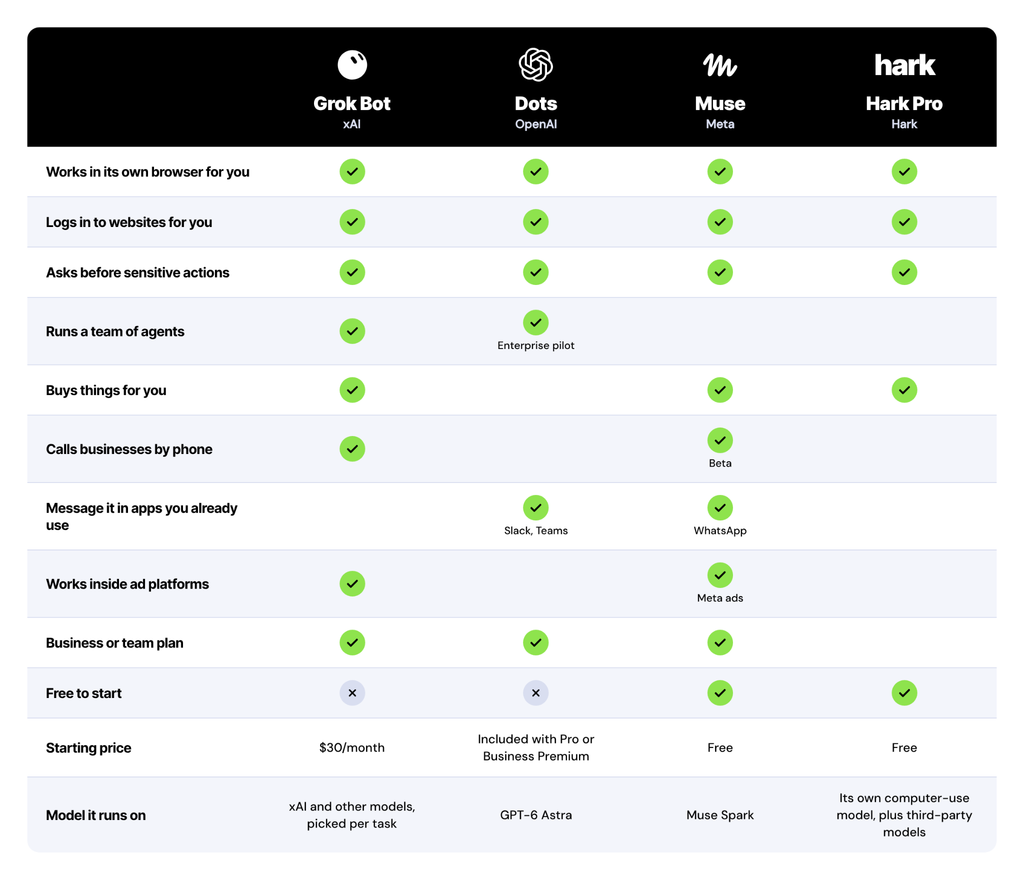
Two more contenders on the horizon include Anthropic’s Claude Duet, which is in research preview at the time of writing this, and is available by waitlist for US Claude Pro and Max subscribers. And Instinct, launched invite-only in August, works over iMessage or WhatsApp.
Why start with your own workflows
The enterprise potential for personal AI agents is legit: OpenAI is already building specialist dots for business teams and has tested them inside OpenAI on procurement, invoice processing, and email marketing. Picture agents that watch campaign pacing or flag a drop in lead quality before Monday meetings while the team is out.
Getting there will take time to do right. OpenAI’s enterprise version is a beta that workspace admins must turn on, Duet is waitlist-only, and governance controls are still being built. On privacy, Instinct had to revise its first privacy policy after criticism of its overreach, and Meta’s own safety post says its policies restrict but don’t prevent Meta’s access to Muse data when needed to run the service.
As these products get polished for enterprise adoption, now is the time to test them out: pick a personal workflow with a clear finish line: triaging your inbox, preparing for meetings, booking travel, or researching a competitor before a quarterly review.
Give an agent that responsibility for two weeks. See where it saves you time, where it delights you unexpectedly, where it needs correcting, and which approvals you would hand off.
Those experiences will highlight the possibilities these products have for your business. At Level, we evaluate and select AI tools before they reach client work, and we approve AI work before clients see it. Leaders who have used these agents firsthand will write better requirements and set realistic expectations with their CFO.
The personal AI agent era is here, and these products’ features and capabilities will evolve quickly. Every vendor demo is flawless. Your inbox isn’t. Put an agent on your own messy work first, and you’ll know which questions to ask before anyone signs a contract.