Google’s lead-generation event in New York went from Think Leads last year to Rethink ROI this September. The new name signals Google’s confidence that its AI can help marketers win more valuable customers, if they provide the data to understand what makes a customer valuable.
Your potential customers increasingly use AI to research purchases, while Google’s systems automate targeting and bidding. Tell those systems what success looks like, using CRM data that shows which leads became customers.
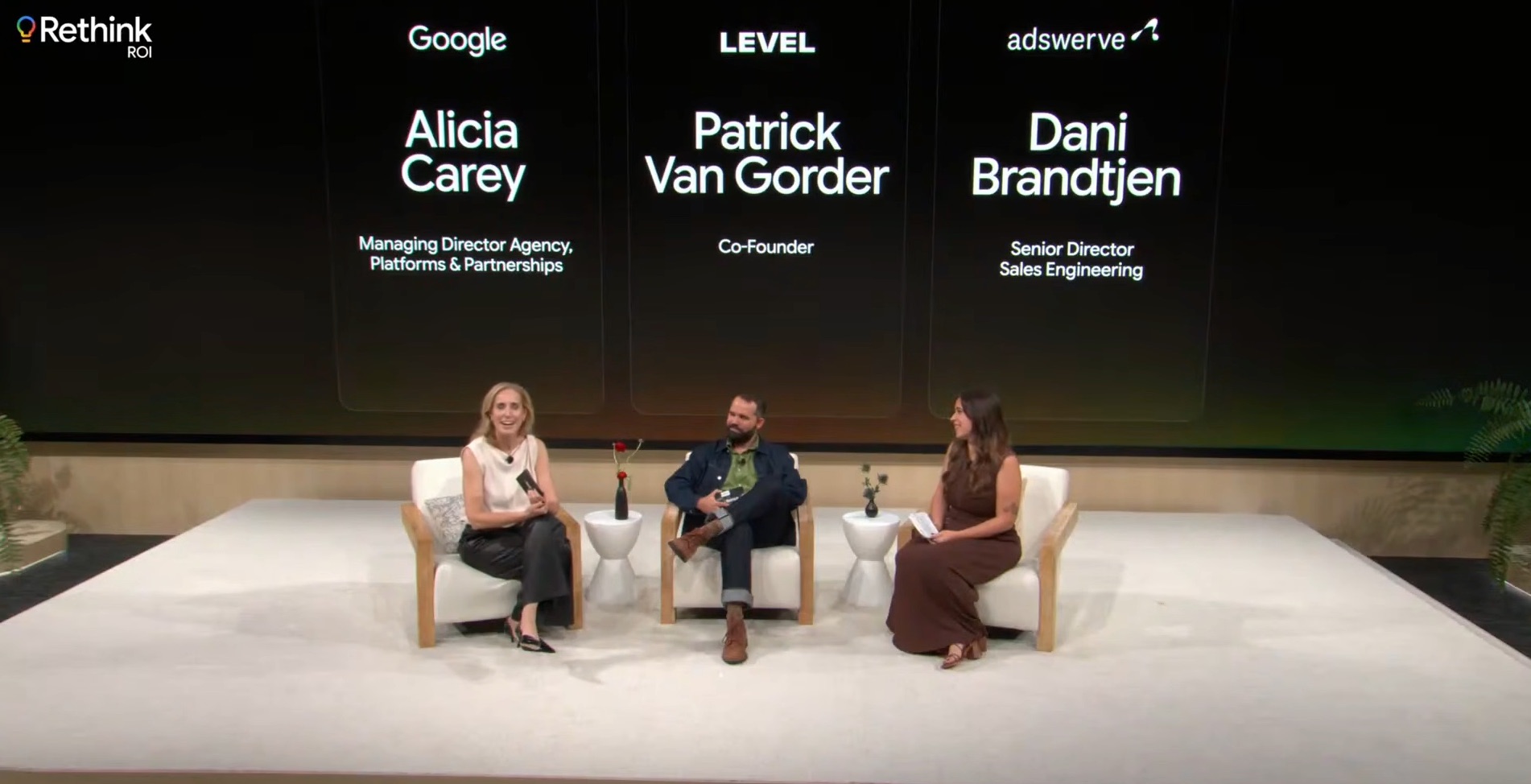
At its Rethink ROI event on September 17, Google invited Level on stage to show that approach in practice. Patrick Van Gorder, our Chief Partnership Officer, joined a panel on data strength hosted by Alicia Carey, Google’s Managing Director for Agency, Platforms, and Partnerships.
The event featured results from our work with Columbia Southern University and StrataTech Education Group. Both shared CRM outcome data. We used it to estimate new leads’ enrollment likelihood, then sent those estimates as scores to Google’s bidding systems to optimize toward enrollments.
Level’s approach required decisions beyond campaign settings: agreeing with finance on the outcome marketing should deliver, securing access to customer data, and testing whether campaigns produced additional growth.
These five steps draw on Google’s speakers, Pat’s experience, and our client work.
1. Agree with finance on the outcome marketing should produce
Pat urged marketers to judge campaigns by the growth they produce. He suggested replacing “what does my direct click conversion performance look like” with “how am I driving incremental growth for the business.”
David Kaul, Google’s Managing Director of Data, Measurement, and Analytics, called for marketing and finance to agree on one critical KPI. In her opening keynote, Melissa Poulos, Google’s VP of US Sales, said marketing teams need to define high-quality leads for Google so its bidding can prioritize the outcomes that matter most to their businesses.
Agree with your CFO on the business outcome marketing should produce before changing campaign settings. Then use your CRM history to identify which leads reached that outcome and what they had in common, so Google’s bidding can value new leads on the same basis.
Google’s bidding optimizes toward the conversions you report. To aim beyond form fills, report the customer outcomes recorded in your CRM.
2. Give the platforms your CRM signal, or fly blind
Your outcome definition matters more now that Google’s AI decides which searches your ads appear for.
Poulos said people using AI engage with nearly three times as many touchpoints as those who don’t. AI Max, a set of AI features for Google Search campaigns, matches ads to what a searcher intends without relying on keyword matching. Google’s AI can find interested people, but it can’t tell which of them will enroll, fund an account, or sign a contract unless you send it that outcome data.
Pat called bidding without the right data “flying blind.” That’s why we won’t take on a client that won’t share the CRM data we need to be confident we can win for them. The results at StrataTech show what changes when that data guides bidding.
At StrataTech Education Group’s schools, enrollment data arrived too late to guide bidding, so Google optimized for the likelihood of a form submission without timely feedback on which leads became students. Many clients face this problem, so we built Level.Signal in partnership with Google to solve it.
Signal estimates each new lead’s conversion likelihood from a client’s past outcomes, then sends ad platforms a score their bidding systems use to prioritize likely customers. For StrataTech, we analyzed two years of LeadSquared CRM data to identify attributes associated with enrollment, including distance from campus. The model estimated new leads’ enrollment likelihood from those relationships. We sent the scores to Google Ads as offline conversions for value-based bidding.
StrataTech’s lead-to-enrollment rate rose 72%, and its cost per enrollment fell 24%. Stephanie Gallo, StrataTech Education Group’s Senior Director of Marketing and Public Relations, described the shift “from chasing volume to focusing on quality.” If full CRM access is the obstacle, begin with a smaller test to build the case for sharing more data.
3. Prove results with a small data test before asking for full CRM access
Your legal and IT teams have good reason to withhold customer data until an agency shows results. Pat described our work with a B2B cybersecurity client cautious about sharing its data.
We assigned a higher synthetic conversion value to demo requests and a lower value to early-stage content downloads. Through enhanced conversions, we sent those values to the client’s AI Max campaigns. Pat reported a 20% improvement in campaign performance, a result we could use to request more data.
Google’s product specialists gave the same advice in the event’s closing segment: crawl, walk, run.
4. Make data strength a CEO decision
A successful small test supports a request for broader CRM access. Pat explained the biggest mistake is treating data strength as an “IT or architecture conversation” when it belongs in a “fundamental business strategy conversation.”
At Columbia Southern University, the conversation started with the CEO, who asked why the university wasn’t growing faster. Pat recalled our diagnosis as “a data strength problem.” CSU had the lead volume it needed, but the challenge was turning those leads into enrollments.
Working with Google’s CSU reps, we first put three measurement foundations in place:
- Enhanced conversions: matches CRM outcomes to ad interactions using hashed customer details.
- Google Tag Gateway: serves tags through your own domain for more reliable measurement.
- Server-side Google Tag Manager: processes measurement data on a server you control before sending it to platforms.
Those tools sent clean conversion data to Google. Enrollments still came too late to guide bidding, so we used CSU’s CRM history in Level.Signal to estimate each new lead’s likelihood of enrolling. We then sent those scores to Google for value-based bidding.
Google showed the results on the main stage: 111% more brand searches and five times higher conversion rates when CSU added Demand Gen to its search campaigns. Google also highlighted attributed branded searches as a way to connect YouTube ad exposure to later Google searches.
The leader accountable for growth in your company should sponsor the work to secure CRM access.
5. Prove incrementality first, then run search and YouTube as one system
Kaul called for incrementality tests before using marketing mix and attribution models to set budgets. A causal test estimates how much growth advertising added, giving those models evidence to inform budget decisions. For example, a YouTube campaign may be credited with sales that would have happened anyway. A controlled test compares outcomes with and without the ads to estimate how many sales they added.
That evidence helps you plan search and YouTube together. Poulos urged marketers to run both as “one unified strategy,” reflecting how your potential customers use both throughout their purchase decisions.
At Level, growth compounds when disciplines work together toward business outcomes. What we learn from each campaign informs our next media, creative, and budget decisions.
Meridian, Google’s marketing mix model, can use incrementality experiments to inform its estimates of channel returns. Pat announced at Rethink ROI that Level is now a Meridian Certified Partner. That gives you a qualified partner to help apply the model to your business, interpret its findings, and turn them into decisions about where to increase investment and where to pull back.
Why Google put Level on stage
Google put Level’s client results on its main stage to show what its technology can deliver when paired with the right data and agency expertise.
Alicia Carey introduced us as “one of the most exciting independent agencies in Google’s partner ecosystem,” highlighting Level’s focus on “driving profitable business growth for businesses with complex customer journeys.” If you manage long sales cycles, that’s a strong endorsement of Level as a partner that can turn Google’s AI capabilities into growth for your business.
Read the full StrataTech case study. Then agree with your CFO on the customer outcome to measure, record it in your CRM, and have your media team import those conversions into Google Ads and make them a bidding goal.
Bidding toward the customer outcomes your business values gives your CFO a meaningful basis for evaluating campaign decisions. Test the incremental return to decide where to spend the next dollar.
Get in touch to learn more about Level.Signal or any of our other proprietary connected growth tools.