An interview with Geoff Roebuck, Higher Education Account Director

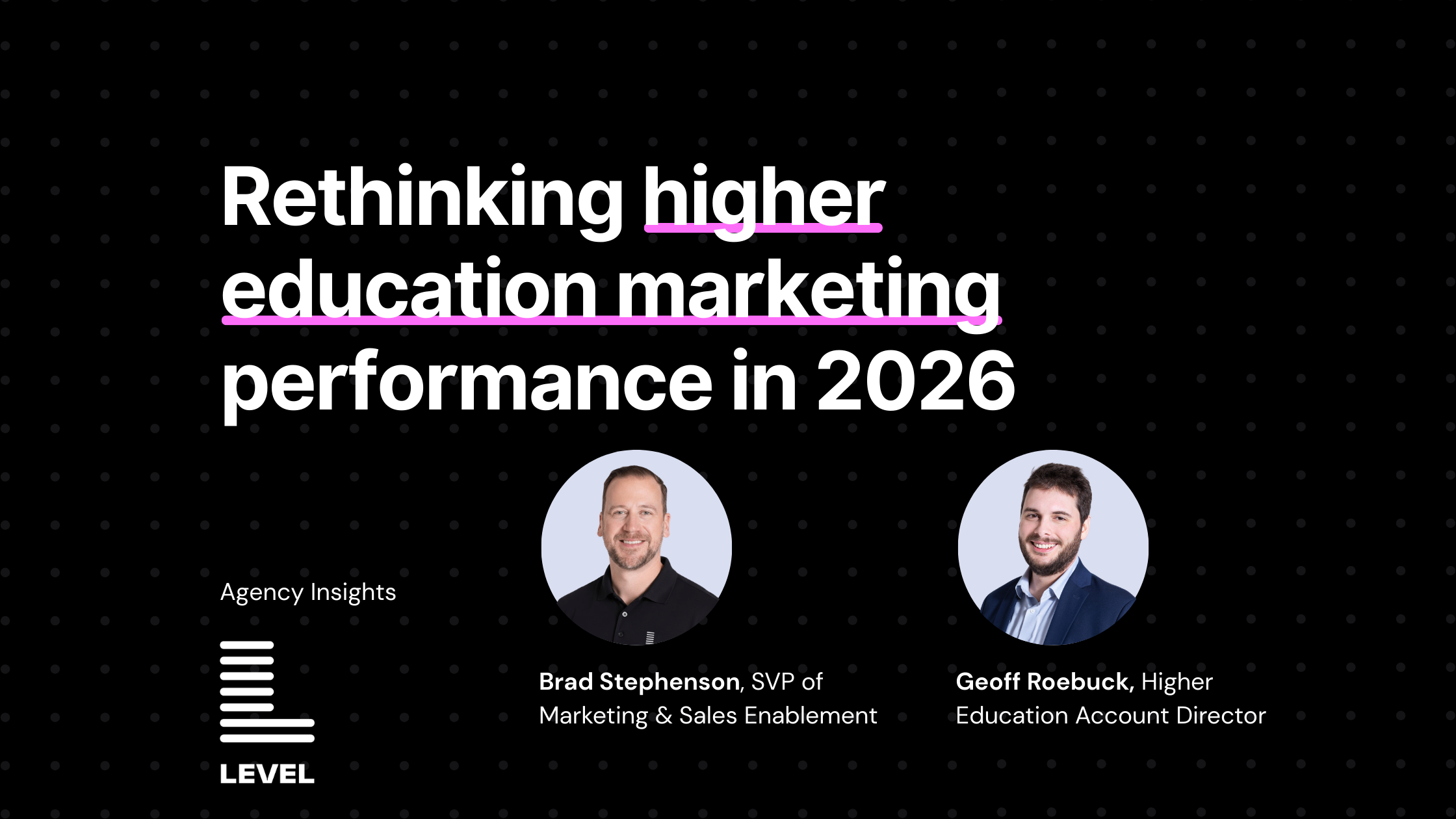
As part of our process to develop our annual higher education benchmarks report, in partnership with LeadSquared, Brad Stephenson, SVP of Marketing and Sales Enablement, interviewed Geoff Roebuck, one of our higher education account directors.
The goal: pressure-test what we’re seeing in the market, clarify what data we should be pulling, and identify the stories that will matter most for higher education marketing performance heading into 2026.
Before diving into the full conversation, here are a few key takeaways:
Key takeaways
- Higher education marketing performance is being redefined. Smart institutions are moving beyond last-click thinking and taking a more holistic view of awareness, SEO, AI visibility, and long-term funnel health.
- AI search in higher education is compressing clicks, but expanding influence. Impressions are rising while site visits decline, meaning more decision-making is happening before a student ever clicks.
- Technical architecture matters more than ever. Institutions must structure content so AI systems (ChatGPT, Gemini, Google AI Overviews) can accurately interpret and represent them.
- Reddit and peer communities carry outsized influence. But engagement is high-risk, high-reward and nearly impossible to undo if handled poorly.
- Trades and career-oriented programs continue to surge. AI-specific degree programs are growing fast, but long-term viability remains uncertain.
- Advanced measurement requires cultural alignment. CRM sophistication and modeling only work when leadership, marketing, and enrollment are fully aligned.
The interview
Brad: As AI becomes embedded across marketing and enrollment workflows, how are leaders rethinking what “good higher education marketing performance” actually looks like heading into 2026?
Geoff: More than ever, they’re thinking holistically instead of directly. Institutions are recognizing that awareness, SEO, and now AI SEO for universities isn’t optional, they’re foundational.
So much of the student journey is happening outside their control. Prospective students are making decisions before they ever search for a school on Google. Website visitation is dropping, not because interest is down, but because people are gathering information elsewhere.
That means content quality matters more. Technical foundations matter more. Information architecture matters more. Schools need to structure their sites so AI systems interpret them correctly and ChatGPT or Gemini are less likely to hallucinate details and more likely to accurately reference them.
The smart institutions no longer see SEO or awareness as cost centers. They see them as business-critical infrastructure.
Brad: How are we—and our partners—thinking about measurement in this world? Especially when brand and top-of-funnel impact has always been hard to quantify?
Geoff: It’s about the total picture.
Instead of asking, “How many search leads did we get this month?” we’re asking:
- How many direct, organic, and search leads did we get?
- What’s the quality of those leads?
- Are they moving down the funnel faster?
- Are applications converting more efficiently?
We’re also looking at metrics like brand click-through rate. Maybe brand search volume is down, but CTR is double what it used to be. That can signal stronger confidence because students have already gathered information elsewhere before clicking.
Another example: impression volume by search feature. If AI Overview visibility is increasing month over month—even if clicks are down—that’s a structural win.
The key is getting creative with traditional metrics and combining them into a bigger narrative. Don’t panic just because brand search leads dip if your broader ecosystem is healthy. Market behavior has changed; your measurement model has to evolve with it.
Brad: Where are institutions most unprepared for the shift away from last-click attribution?
Geoff: When they overreact to direct signals.
If leaders see leads decline and immediately revert to what worked in 2000, they’re optimizing toward zero. They’ll lean into short-term tactics and ignore long-term infrastructure like SEO, content, and awareness.
The institutions that win are the ones that:
- Measure long-term SEO impact
- Understand the role of content
- See the full funnel rising, not just individual channels
If you focus only on rising non-brand search costs without seeing the bigger picture, you’ll make the wrong strategic shift.
Brad: How is AI-driven search in higher education changing how prospective students research schools?
Geoff: It’s not a total paradigm shift, but it’s significant.
Students are using tools like ChatGPT earlier in the research process. They rely less on traditional Google results. That said, Google still drives the majority of organic traffic.
What’s changing is this: impressions are going up, but clicks are going down. More of the conversation is happening in AI environments that institutions can’t directly track.
That’s why information architecture is so critical. You need your site structured so AI systems interpret it correctly when those off-site conversations happen.
We’ve even seen cases where AI summaries gave students incorrect operational information about a college being closed for a holiday because the AI inferred closure from broader state data. That’s a structural issue, not a marketing one.
Small technical gaps can now produce large perception problems.
Brad: Has AI changed how leaders think about personalization?
Geoff: The expectation for relevance is higher, but there’s a ceiling.
Moving from generic messaging (“Welcome to our campus”) to program-specific messaging (“Welcome to the MBA program. Here are your course pathways”) is essential.
But deeper personalization can feel creepy. Most institutions aren’t using hyper-individualized AI video or heavy personalization at scale.
AI is powerful for enabling that mid-layer of personalization—program, degree type, career path—but institutions need to stop before it feels invasive.
Brad: Which program categories are structurally stronger heading into 2026?
Geoff: Trades and associate programs continue to grow. Career-oriented programs with clear ROI are driving enrollment.
Liberal arts and graduate students are typically mission-driven and passionate already. But the growth momentum is clearly in practical, workforce-aligned programs.
Every institution has recognized that trend and is scrambling to respond.
Brad: What about AI-specific degree programs?
Geoff: There’s a rush to market with AI-branded degrees: AI engineering, AI master’s programs, and so on.
Personally, I’m skeptical about long-term sustainability. The field evolves so quickly that curricula could be outdated within months. But there’s real excitement in the market, and some of these programs are performing well.
If I were advising institutions, I’d focus on AI-resilient programs. Fields that can’t easily be automated, like trades or hands-on professions.
AI programs may thrive, but we don’t yet know what they’ll look like in 5–10 years.
Brad: Beyond search habits, are you seeing other behavioral shifts among prospective students?
Geoff: Students rely more heavily on peer networks and trusted communities, especially Reddit.
Reddit can dramatically influence organic visibility and perception. Positive threads help. Negative sentiment lingers for years.
Institutions are asking more about engaging on Reddit and YouTube, but organic engagement is high risk.
You can’t half-do it. It has to be authentic, faculty- and student-driven, well-monitored, and genuine. If it goes poorly, you may not recover.
In higher education especially, tread lightly.
Brad: What separates institutions that successfully operationalize advanced CRM measurement from those that stall?
Geoff: Cross-leadership buy-in. It’s essential for improving higher education marketing performance.
The institutions succeeding have alignment across marketing, enrollment, executive leadership, and academic deans. Everyone agrees on the goal, the urgency, and the roadmap.
If you have silos, conflicting reports, or personality-driven friction, the system breaks. Sales does one thing. Marketing does another. The CEO sees three dashboards telling five different stories.
AI won’t fix that. Culture does.
Brad: As we build this year’s higher education marketing performance benchmarks report, what aggregate data should we prioritize?
Geoff: Look at the institutions that are doing everything right:
- AI SEO implementation
- Predictive modeling
- Value-based bidding tied to enrollment cycles
- Clean CRM signal flow
- Cultural alignment
There aren’t many, but the ones who do have it are showing real growth.
Case-study those institutions. That’s where the story is.
Final thoughts
AI in creative is harder in education than in ecommerce. Ecommerce can experiment with product visuals. Education is human, story-driven, and trust-based. Authenticity matters more.
But experimentation still matters.
Don’t be afraid to test AI in creative. Bad engagement is still engagement algorithmically. If you’re delivering the right message to the right students with programs that genuinely solve their challenges, the fundamentals still win. That’s ultimately what drives sustainable higher education marketing performance.
Just maybe don’t experiment recklessly on Reddit. Speaking of Reddit, check out our virtual insider session with our platform partners on March 19, 2026, at 1 PM Eastern. (Or watch on demand if the date has passed!)
Stay tuned for our full 2026 Higher Education Benchmarks Report, developed in partnership with LeadSquared, where we’ll bring these themes to life with aggregate data, growth case studies, and actionable guidance for higher education enrollment marketing and industry leaders.