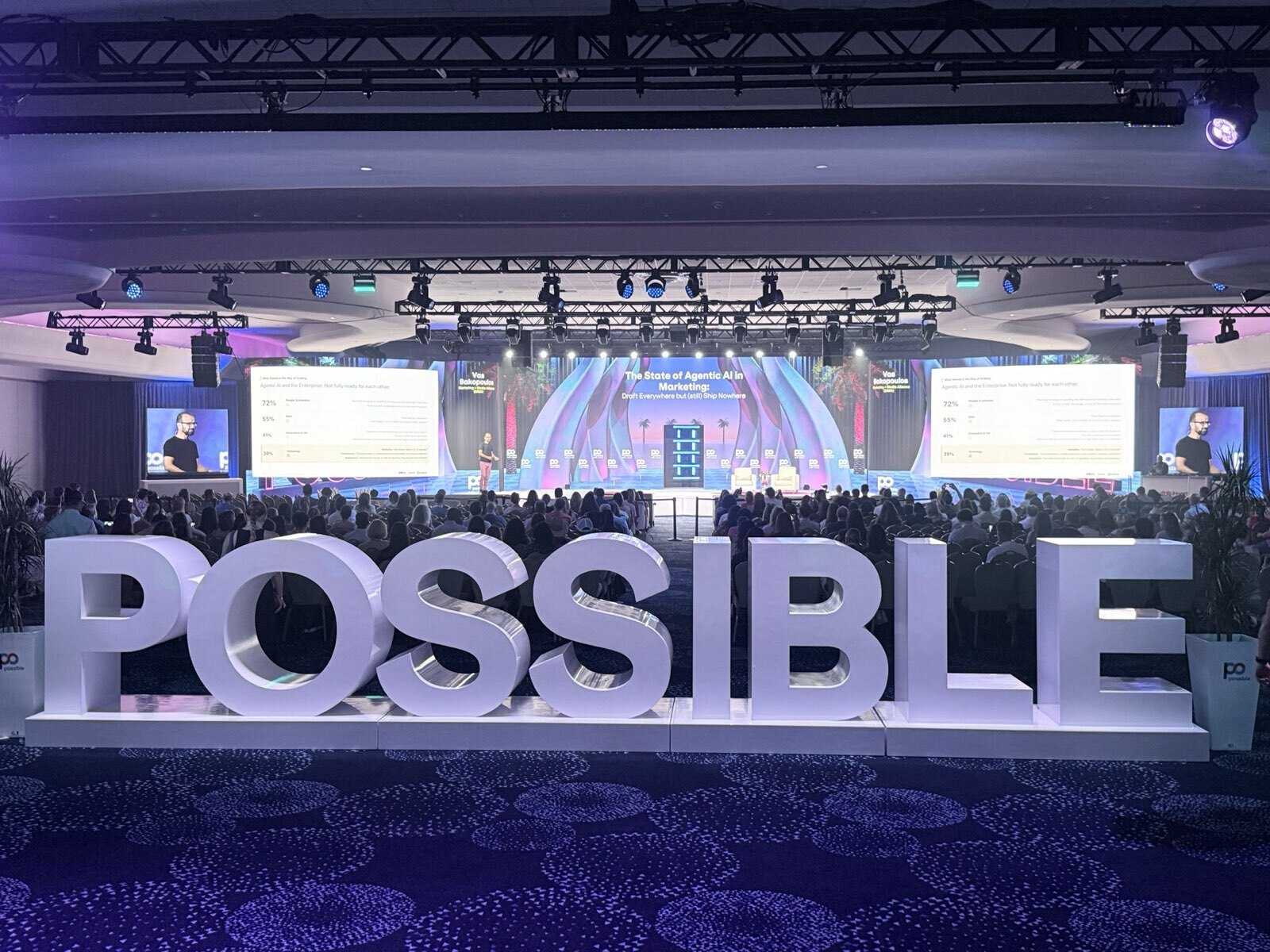
Possible 2026 · A Level Agency POV
What Possible 2026 made impossible to ignore.
Three days in Miami. 7,500+ marketers. The conversations that kept coming up weren't about better ads — they were about whether ads, as we've known them, still work.
That's unsettling if you're defending a legacy playbook. Energizing if you're built on the scientific method and a data-first mentality. Disruption at this scale doesn't just create risk — it creates structural opportunity for the brands and partners willing to test, measure, and adapt faster than the market.
April 27–29, 2026 · Fontainebleau & Eden Roc, Miami Beach
Begin reading01 · The Frame
The age of opinion
is ending.
Greg Stuart — CEO of Marketing + Media Alliance (MMA) and Possible co-founder — opened the conference with a thesis that anchored the whole three days. Marketing must transition from opinion-based practice to science-based methodology, because the science already exists, and the profession just isn't using it.
Only that — the sales lift from a 10% increase in ad spend, on average. Far less than the proportional return most marketers assume.[1]
Of every promotional dollar — wasted. Simply redistributing demand the brand would've captured anyway, generating none of it new.[1]
Greater than advertising's sales impact at the system level. Distribution moves the needle far more than advertising does — the lever every CMO is under-pulling.[1]
Marketing isn't yet a true profession. It lacks standardized scientific education.
— Greg Stuart, CEO, Marketing + Media Alliance
This is Stuart's third year of the same critique, evolved each time. Year one: marketing resembles medicine in the 1800s — bloodletting era. Year two: marketers are too busy to do better. Year three: the profession itself is incomplete.
Each of the themes that follows is a specific instantiation of that argument. Vassilis Bakopoulos's MMA agentic-AI research. Terry Kawaja's reckoning thesis from LUMA. The incrementality panel's CFO framing. The Pepsi × Walmart Connect retail-signals story. They're all answers to the same question: what comes after opinion-based marketing.
02 · Theme One
The funnel is
collapsing.
The linear path from awareness to purchase is compressing fast — and shopper media has stopped being a bottom-of-funnel conversation. For brands operating at scale, upper-funnel and lower-funnel are no longer separate strategies. They're the same one, and the brands that recognize that earliest get a structural advantage.
PepsiCo Beverages U.S. portfolio (Pepsi, Mountain Dew, Gatorade, Lipton, Starbucks RTD) — Mark Kirkham's CMO domain.[3]
& HHP
Replacing impressions, CPMs, and ROAS as the success metrics for retail media.[4]
Strategies that scale start with retail signals. Signals that matter measure impact from content to cart.
— On-stage slide, "A Prebiotic Plot Twist" panel
PepsiCo's launch of Pepsi Prebiotic Cola with Walmart Connect was the cleanest case study to date. Walmart's first-party shopper signals shaped the brief, not just the report card — informing creative iteration, pricing, and broader go-to-market planning. The implication: retail data is now an input to the upper funnel, not just an output of the lower one.
Kyle McWhirter, who runs Walmart Connect's food category, framed the metric shift directly: retail media is moving past impressions, CPMs, and ROAS, toward velocity and household penetration as the success terms. For mid-market and enterprise brands, that compresses the org chart. The teams running creative, media, and retail can no longer operate from separate truths.
The other half of the funnel-collapse story is happening in CTV and on the open-internet programmatic surface. The same first-party-data shift that turned Walmart Connect's signals into a creative brief is reshaping upper-funnel media — addressable CTV, DSP-side audience activation, and open-web programmatic are converging into a single operating model where shopper data, CTV reach, and programmatic delivery share a stack. The agencies and brands running those as one system will out-plan the ones running them as three.
03 · Theme Two
Agents don't
click.
The most provocative thread at Possible 2026 wasn't about a platform or a tactic. It was an infrastructure argument — and the data Cloudflare's Matthew Prince brought to it made the click-based performance model look genuinely fragile.
9× more crawl, same traffic out. Google now crawls 18 pages for every visitor it sends back. Ten years ago, the ratio was 2:1. AI Overviews drive most of the shift.[5]
Pages OpenAI crawls per visitor returned — and that's the moderate end. Some AI platforms have reached ratios in the hundreds of thousands.[5]
Of internet traffic worldwide flows through Cloudflare; 80% of leading AI companies are Cloudflare customers.[5]
The Google search user is in Cleveland, getting divorced, needs a lawyer. Three signals. The AI chat user starts with a 25-word prompt and has multiple interactions. That's a different unit of intent.
— Terry Kawaja, Founder & CEO, LUMA Partners (see Session 09)
Cloudflare sits behind roughly a fifth of the internet, and 80% of the leading AI companies are Cloudflare customers. Their data argues that the trade that funded the open web — search engines crawling content, sending traffic back — has broken. AI Overviews answer the query before the click happens. Agents don't click ads. The IAB is already responding: they're building a framework for "agent commerce attribution" because current models cannot account for discovery that happens inside an LLM.[5]
Terry Kawaja's keynote arrived at the same conclusion from a different angle. The richer signal of an AI prompt — twenty-five words on average, multi-turn, descriptive of situation and need — outclasses the three-token query Google was built on. That shift doesn't deprecate search. But it does deprecate the click as a unit of accounting — and that has direct consequences for the open-web programmatic surface, where the click has been the primary unit of value exchange for two decades. The brands that build for the new measurement surface first — across search, programmatic, and CTV — will have a multi-year structural advantage.
04 · Theme Three
Brand is verifiable,
not just memorable.
The Possible conversation around brand was not a return to creative-awards language. It was a practical argument about what brand has to do in an agentic world — where an AI agent acting on a consumer's behalf might evaluate thousands of signals in seconds and never see a homepage.
"Actually very cheap. All earned."[6]
Kraft Heinz North American portfolio Todd Kaplan now leads — 50+ brands across 40 categories.[6]
Picture
Spotlight (2015). Michael Sugar's anchor credit and the foundation of Sugar23 — on stage with Kaplan.[7]
There's no such thing as branded content. There's good content and bad content. View your brand as IP.
— Possible 2026 mainstage panel, Kaplan & Sugar
A human consumer might visit five websites before a purchase. An AI agent might visit thousands, in seconds, with no response to homepage design, brand story, or banner advertising. Agents don't notice branding. They evaluate signals and present conclusions.
The brands that earn LLM recommendations won't be the ones with the biggest ad budgets. They'll be the ones with the clearest, most consistent, most trustworthy signals across every surface where AI is listening. Marissa Florindi Solan, Director of US Earned and Social Media at Haleon (Advil, Sensodyne, Theraflu, Tums), has been making the same argument in her own published writing: "Gaining an understanding of how our brands are perceived by LLMs has been incredibly illuminating."[8]
The Kaplan/Sugar thesis lands the same observation from the other end of the funnel. The path from "ads as rented real estate inside Seinfeld" → "branded content" → "brands as the source of the entertainment" is the long arc of becoming verifiable IP. The Wienermobile's 6.3 billion impressions were earned, not bought, because the brand is the thing being recommended — not the thing being inserted.
05 · Theme Four
Creator is
the new channel.
The Creator Economy Academy was new at Possible 2026 — and not a coincidence. Creator-led content is outperforming traditional formats across financial services, home goods, healthcare, and connected TV. The question is no longer whether to invest in creators. It's whether you have the measurement infrastructure to prove it, and a creative framework to scale it past one-off engagements.
Deon's 7-episode street-racing series, released December 2025 as part of the Tubi for Creators program. The arc from YouTube to platform-level original programming.[9]
Speakers across the new Creator Economy Academy — a track that didn't exist last year. Issa Rae (HOORAE), Kinigra Deon, Caden Cox (CreatorIQ), Charlamagne tha God, Bob Pittman (iHeartMedia).[10]
Wouldn't you rather talk to the expert than to an influencer second-hand?
— The Conversation Era panel, Snap × Experian
Mary Ellen Coe, YouTube's Chief Business Officer, put a creator/filmmaker on stage with her — Kinigra Deon — and that pairing was itself the message. YouTube isn't framing the next era as 30-second ad inventory. It's framing it as appointment viewing, with creators producing serialized cinematic content that travels across platforms (Tubi, in Deon's case) and across formats.
The companion thread came from the messaging panel. Snap's Ajit Mohan and Experian's Steve Hartmann landed on the same point: as AI mediates discovery, the trusted expert in a conversation outranks the influencer mentioning a brand secondhand. The creator economy and the conversation era are the same shift, viewed from different surfaces — discovery moving from one-to-many broadcast into one-to-one, expert-mediated, increasingly synthetic dialogue.
06 · Theme Five
Measurement is moving
from reporting to causality.
Retail media is increasingly first-party. CFOs are scrutinizing KPIs harder than they have in years. And the empirical work coming out of the MMA argues that the bottleneck for marketing isn't AI capability — it's people, process, and the willingness to put a system between the agency and the report card.
Share of marketers running fully autonomous agentic AI today. The gap between announcing agents and shipping them is wide.[11]
Share of marketers with detailed, hands-on AI knowledge. They scale on evidence, not permissions, and significantly outperform peers.[11]
cite People & Process as the top blocker to scaling agentic AI — followed by Data (55%), Governance & Risk (41%), and Technology (39%). The model is rarely the limiting factor — the operating system around it is.[11]
Measurement is a blend of strategy and science.
— Kim Winburn, Senior Manager, Media Effectiveness, Mars
The incrementality panel — Robin Wheeler (CRO, Fetch), Kim Winburn (Mars), Diane Bollig (Mars United Commerce) — gave the working stack. MMM annually or twice a year as long-cycle truth. Test-and-learn as real-time confidence. Continuous optimization. And the structural move: independent verification — methodology and outcomes that hold up end-to-end, not taken on anyone's word. Fetch's contribution to the panel was a specific approach: hold-out testing as a primary incrementality method — and Wheeler was describing her own company's work.
The CFO framing the panel landed is the most usable artifact in either direction. Two questions any CFO will ask, and the metric each maps to:
Bakopoulos's research is the empirical spine for everything above. Where agentic AI is concentrated today (30% of paid media is autonomous), where it's heading next (33% of marketers plan to deploy it in Creative & Content, 28% in Marketing Ops), and what's stopping the growth (72% blame people and process; only 39% blame the technology). The capability isn't the problem. The willingness to rebuild the operating model around the capability is.
07 · Reference
9 of the sessions
that shaped our thinking.
Possible 2026 ran dozens of sessions across multiple stages. These are the ones that most directly informed our perspective. Click any to expand for full speakers, key takeaways, slide content, and quotes.
01 The Thrift That Got Away: Turning FOMO into Foot Traffic with AI Tim McCracken (BarkleyOKRP) · Lt. Col. Mark Nelson (The Salvation Army) · John Nicoletti (Google) Image generator Nano Banana turned thrift's "every item is 1:1" constraint into a creative weapon — showing recently-sold rare items to drive FOMO foot traffic.
Speakers
- Tim McCracken — SVP, Creative & AI / Head of AI, BarkleyOKRP. Architect of "Thrift That Got Away" and the sibling "Thrift Score" Roblox launch (Feb 2026).
- Lt. Col. Mark Nelson — ARC (Adult Rehabilitation Centers) Commander, The Salvation Army.
- John Nicoletti — Managing Director, Global Product and Sales Activation, Google. Formerly Industry Director, Retail.
Key takeaways
- The "impossible brief": every SKU in a thrift store is 1:1. There is no second one of anything.
- "Prove out what is NOT in store". The biggest hidden value is the items that walked out the door — a survival-bias framing applied to thrift inventory.
- BarkleyOKRP used image generator Nano Banana to transform stock photos into creative showing recently-sold rare items, "turning absence into attraction."
- Two essentials in the age of AI abundance: (1) a big idea with the human at the center; (2) craft that demands you notice and pay attention.
02 What Does It Take to Prove Incrementality? Robin Wheeler (Fetch) · Kim Winburn (Mars) · Diane Bollig (Mars United Commerce) Measurement is a blend of strategy and science. MMM is the long lever; test-and-learn is the confidence builder; independent verification is the credibility move.
Speakers
- Robin Wheeler — Chief Revenue Officer, Fetch. (Yes — when the panel said "Fetch uses a hold-out," that was Wheeler describing her own company's methodology.)
- Kim Winburn — Senior Manager, Media Effectiveness, Mars.
- Diane Bollig — Senior Director, Client Leadership, Mars United Commerce.
Key takeaways
- JTBD framework laddering to business goals — anchor every measurement decision to the job the business is hiring marketing to do.
- "Leaky bucket" — the gap between measurement ambition and what actually gets proven.
- MMM is the biggest lever, but only at the right cadence. Annual or twice a year for long-cycle truth; test-and-learn for real-time confidence; continuous optimization on top.
- Independent verification of measurement: methodology and outcomes that can be validated end-to-end, not taken on the practitioner's word.
- The CFO framing: "What am I going to get to fund this?" → coefficient/causal ROI. "Do I have confidence I'm hitting the sweet spot of the return curve?" → half-life, % of optimal.
03 The Blurred Lines Between Brands, Culture, and Entertainment Todd Kaplan (Kraft Heinz) · Michael Sugar (Sugar23) Find and activate your latent IP. There's no such thing as branded content — only good content and bad content. The Wienermobile's 6.3B earned impressions are the canonical case for brand-as-IP.
Speakers
- Todd Kaplan — CMO, North America, The Kraft Heinz Company. Joined July 2024 from PepsiCo, where he was CMO of the flagship Pepsi brand for 17 years (led the 2023 Pepsi rebrand, Nitro Pepsi, Pepsi × Peeps).
- Michael Sugar — Founder & CEO, Sugar23. Academy Award-winning producer (Best Picture, Spotlight, 2015). Other credits: 13 Reasons Why, Maniac, The Knick. Multi-year first-look feature deal with Netflix.
Key takeaways
- "Find and activate your latent IP". Most brands already have IP equity they're not using.
- "No such thing as branded content" — there's good content and bad content. View your brand as IP.
- Wienermobile / "Weenie 500": 6.3B impressions, "actually very cheap — all earned."
- The arc: ads as rented real estate (Seinfeld era) → branded content → brands as the source of the entertainment. Consumers opt in to the story.
04 A Prebiotic Plot Twist: How Pepsi Rewrote the Playbook with Walmart Connect Mark Kirkham (PepsiCo) · Kyle McWhirter (Walmart Connect) Walmart Connect's first-party signals shaped the brief for Pepsi Prebiotic Cola — informing creative iteration, pricing, and go-to-market — not just measuring impact after the fact.
Speakers
- Mark Kirkham — CMO, PepsiCo Beverages U.S. $28B portfolio: Pepsi, Mountain Dew, Gatorade, Lipton, Starbucks RTD. 15-year PepsiCo veteran, prior CMO of PepsiCo International Beverages.
- Kyle McWhirter — Group Director, Head of Food, Walmart Connect. Adage 40 Under 40, 2025.
Key takeaways
- "Strategies that scale start with retail signals. Signals that matter measure impact from content to cart. Customer intelligence shapes full-funnel creative and media solutions." — slide.
- The Pepsi Prebiotic Cola launch used Walmart Connect retail signals to drive full-funnel creative and media decisions, not just bottom-of-funnel measurement.
- Retail signals shape the brief, not just the report card.
- Success metrics shifting from impressions / CPMs / ROAS toward velocity and household penetration.
05 MMA: 10 Big Things Marketers Get in 2026 Greg Stuart (MMA / Marketing + Media Alliance) Stuart's annual ten-item agenda. Confirmed items include AI-Personalized Advertising, Brand-as-Performance ($3M MMA study), and org-design ROI insight.
Speaker
- Greg Stuart — CEO, Marketing + Media Alliance (MMA) and Possible co-founder. Hosts the Building Better CMOs podcast.
Key takeaways
- The MMA's annual ten-point research agenda. Each item is grounded in science and designed to help CMOs create more value.
- #4 — AI-Personalized Advertising that optimizes for brand, traffic, and sales.
- #5 — Brand-as-Performance (BaP): a $3M+ MMA study with Ally Financial and TransUnion proving brand drives both immediate and long-term growth.
- #6 — Org-design ROI insight: organizations need clear evidence on which org changes increase sales and which do not.
- Stuart also delivered the conference opening keynote ("The Age of Opinion Is Ending") — the conceptual frame at the top of this page.
06 A New Era of Entertainment: A Fireside Chat with YouTube's Mary Ellen Coe Kinigra Deon · Mary Ellen Coe (YouTube) Creators are no longer building attention. They're building appointment viewing.
Speakers
- Kinigra Deon — YouTube creator/filmmaker. 4.7M+ subscribers, family-friendly feature-length cinematic content. Created Speed, a 7-episode Tubi-exclusive series, December 2025.
- Mary Ellen Coe — Chief Business Officer, YouTube. Previously President, Google Global Customer Solutions. Took over CBO role October 2022.
Key takeaways
- "The conversation era" — marketing has shifted into the age of messaging and dialogue, not broadcast.
- AI + messaging has changed the discovery funnel. The funnel is shorter, messier, more conversational.
- YouTube's positioning: creators as appointment viewing destinations, not short-form attention buys.
- The Deon × Tubi arc — creator content extending into platform-level original programming — is the model for what's next.
07 The Conversation Era: Marketing in the Age of Messaging Steve Hartmann (Experian) · Ajit Mohan (Snap Inc) Discovery is shifting from broadcast to dialogue. Both Snap and Meta are rolling out ads-in-messaging products. The trusted expert in a conversation outperforms the influencer mentioning a brand secondhand.
Speakers
- Steve Hartmann — Vice President of Marketing, Experian Consumer Services. Currently driving Experian's "BFF" brand campaign with Sam Richardson and the March 2026 "Derby Buddies" extension.
- Ajit Mohan — Chief Business Officer, Snap Inc. Promoted from President APAC to CBO in February 2025. Pre-Snap: VP & MD India at Meta.
Key takeaways
- Ads in messaging is a coming product line — both Snap and Meta are pushing into it.
- Snap announced a new product (specifics not captured); early advertiser results were positive.
- The headline frame: "Wouldn't you rather talk to the expert than to an influencer second-hand?"
- Implication: the influencer category gets compressed as AI agents credibly serve as trusted experts inside conversations.
08 The State of Agentic AI in Marketing: Draft Everywhere but (still) Ship Nowhere Vassilis Bakopoulos (MMA, with Media.Monks & IOPEX) AI adoption is broad. Autonomy is almost nonexistent. The modal state of the market is "deploying with human approval." The bottlenecks to scaling are people, process, and governance — not the model.
Speaker
- Vassilis (Vas) Bakopoulos — SVP, Head of Industry Research, Marketing + Media Alliance. Leads MMA's annual benchmarking franchise; long collaborator on SMoX (cross-media studies) and Brand-as-Performance with Ally Financial × TransUnion.
- Co-presenters: Media.Monks + IOPEX (logos on every slide).
Key takeaways
- The market by autonomy × deployment stage:
Exploring (52%) Deploying (35%) Scaling (12%) Autonomous (5%) 0% 4% 1% With approval (57%) 24% 24% — modal 9% Drafts only (38%) 28% 7% 2% - Where agentic is applied today vs. heading next: Paid Media (30% → 12%), Customer Journey (17% → 21%), Marketing Ops (5% → 28%), Creative & Content (5% → 33%), Strategy & Planning (~0% → 4%). The next wave is Creative & Content + Marketing Ops.
- What stands in the way of scaling: 72% People & Process · 55% Data · 41% Governance & Risk · 39% Technology. The model is rarely the limiting factor.
- "Marketers with hands-on experience scale AI on evidence, not permissions." 31% of marketers have detailed hands-on AI knowledge — they outperform peers across decision criteria, infrastructure, maturity, and barrier removal.
09 AI & Advertising: Prepare for Tectonic Disruption Terence (Terry) Kawaja (LUMA Partners) Three tiers of "AI" in ad tech: AI First, Fast Adapters, AI Poseurs (too many to list). The reckoning will favor fewer players doing more volume, at lower take rates, with better quality.
Speaker
- Terence (Terry) Kawaja — Founder & CEO, LUMA Partners. Has advised on $300B+ in transactions across media, tech, and advertising. The industry's "unofficial cartographer" — author of the LUMAscape, and recently the new AI LUMAscape.
Key takeaways
- "2026 is show me the money." The strategic value of AI shows up as one of: faster growth, higher operating margins, or greater revenue per FTE. Agencies' total market cap is down 40% over four years.
- Three tiers of "AI" in ad tech: AI First (companies started as AI-enabled — fewer people, more leverage), Fast Adapters (incumbents that built or acquired real AI products), AI Poseurs (incumbents repositioning for higher exit valuation). "Too many to list."
- AI's hierarchy of application to advertising (pyramid): Workflow / Data / Measurement / Media Buying (efficiency) → Content / Ad Creative / Communication (efficiency + effectiveness) → Internet Navigation (disrupting search) → New tasks we haven't thought of yet.
- "Thoughts on Agentic Advertising": no barrier to announcing agents, de minimis spend so far, focus has been on workflow, key will be AI tech applied to decisioning, trust will be the gating element, full autonomy unlikely for some time.
- Conversion Data Hierarchy: Outcomes (advertising perfected) → Intent → Audience → Context → Attention → Viewable Impression → Impression. Today's data is a proxy for intent; tomorrow's surface measures outcomes directly.
- "AI answers is search intent data on steroids." Google search = 3 signals (Cleveland, divorced, lawyer). AI chat = 25-word average prompt with multi-turn refinement. Different unit of intent.
- "AI will catalyze the long-overdue great reckoning in ad tech." The LUMAscape is a fragmented ecosystem of largely undifferentiated companies that "eke out their existence on rev shares and kickbacks." What's needed: fewer players doing more volume at lower take rates with better quality.
- Creative is the unmeasured lever. "Creative contributes more to ad effectiveness than data or media — but data and media get most of the investment and attention." That's the next frontier.
- Closing: "Agility is the most important trait in this age."
08 · What's Next
What this means for
mid-market and enterprise brands.
We came to listen, to test our hypotheses, and to deepen the partnerships that let us act on what we learn. The conversations that kept coming up didn't validate a settled strategy — they sharpened five questions every marketer leaves Miami needing to answer. The stage case studies were enterprise — but the operating-model shifts they describe land first in the mid-market, where smaller teams can rebuild faster than $30B portfolios can.
The funnel is no longer a funnel.
The retail-media-as-input model is the most concrete case in the room. Brands that treat retail signals as a creative brief — not just a measurement source — will compound.
The click is no longer the unit of accounting.
Building for the agent — verifiable, structured, machine-readable signals across every surface — is now table stakes. The IAB is already standardizing it.
Brand is back, but as a measurement problem.
The brands that earn LLM recommendations will be the ones whose signals across the open web are clearest, most consistent, most trustworthy. That's a research and content-architecture problem, not a creative one.
Creators are the next channel infrastructure.
The measurement infrastructure to prove creator performance, and the creative framework to scale them past one-off engagements, is the agency-side product the next two years will reward.
Causality, not reporting.
Real causal measurement — third-party-validated, hold-out tested, MMM-anchored — is becoming the bar. The teams willing to be held to it will outperform the ones still defaulting to attribution alone.
The agencies that navigate this well won't be the ones that adopted AI the fastest. They'll be the ones that understood what AI changes about the work itself — measurement methodology, creative production, media planning, client-service models — and rebuilt their offerings accordingly.
The window to do that is now, not later.
Talk to Level about
Sources
Bibliography
- Adweek — Possible 2026 Opening Remarks: Marketing's Age of Opinion Is Ending
- Walmart CMO mainstage, Possible 2026 (per Level on-site notes; figure consistent with industry coverage of major-retailer shopper-media share)
- Brand Innovators — Mark Kirkham bio · Adweek announcement
- Adage 40 Under 40 — Kyle McWhirter · MediaPost on Pepsi × Walmart Connect
- Matthew Prince, CEO Cloudflare, Possible 2026 mainstage. Crawl-ratio and zero-click figures consistent with Cloudflare published research and Similarweb 2025 data.
- Marketing Dive — Todd Kaplan CMO appointment · Digiday on Kaplan's creativity defense
- Sugar23 about page · Wikipedia
- Adweek — Brands Wrestle With Broken Measurement · Digiday on AI search gatekeepers
- Television Academy feature on Kinigra Deon · Marketing Brew on Tubi for Creators
- NetInfluencer — Possible 2026 Debuts Creator Economy Academy
- MMA — Vassilis Bakopoulos speaker page. Data from "Draft Everywhere but (still) Ship Nowhere," MMA × Media.Monks × IOPEX research, presented at Possible 2026.
Full speaker bios, source-by-source citations, and the underlying session notes live in our internal extraction. Where a stat is attributed to a session without a public link, the figure was captured live on stage and confirmed against the speaker's published positions.