When measurement gets fragmented, growth gets harder to see.
That’s the challenge many marketers face today. Platform dashboards all claim credit. Reporting gets noisier. Teams spend more time debating attribution than improving performance.
That is why we built Level.Signal, a propensity scoring tool that helps brands align signals into a single source of truth.
Recently, Think with Google highlighted Level Agency for the development of Level.Signal, and noted that its power lies in coupling Google Cloud with predictive search signals.
For one higher-education client, Level.Signal helped drive a 48% increase in applications while also reducing cost per application by 30%.
Higher education client impact
Level.Signal identified which behavioral and media signals predicted enrollment intent and redirected spend accordingly.
Applications
+48%
Increase in applications driven by predictive signal optimization
Cost Efficiency
−30%
Reduction in cost per application through smarter targeting
For us, that recognition matters. Not because it’s a press moment, but because it reflects a bigger shift in marketing measurement: brands need systems that do more than explain what happened. They need systems that help them predict what to do next.
What is Level.Signal?
Level.Signal is Level Agency’s AI-powered measurement and optimization solution built to help brands identify higher-quality prospects, improve media decision-making, and connect performance signals to real business outcomes.
At a practical level, Level.Signal is a predictive modeling tool that brings together multiple inputs that are often left disconnected:
- Behavioral data from website activity
- Lead data submitted by prospects
- Media engagement data
- Predictive modeling to estimate which users are more likely to take the next meaningful step
That allows teams to move beyond basic reporting and start making better decisions about targeting, optimization, and lead handling.
WANT TO LEARN MORE?
Level.Signal Overview (PDF)
Methodology, infrastructure, and predictive modeling approach
Why we built it
Most measurement stacks are good at reporting activity. Fewer are good at helping marketers understand quality.
That gap matters even more in complex, high-consideration industries, where the path from first click to final conversion is longer, messier, and harder to evaluate using last-click logic alone.
We built Level.Signal to help answer a more useful question:
Which signals actually point to future revenue potential, and how should marketing respond?
Level.Signal was built to move teams past backward-looking reporting and toward decisions that improve quality, efficiency, and growth.
Instead of treating every conversion the same, the system is designed to help distinguish between lower-intent activity and the behaviors that suggest someone is more likely to engage, apply, enroll, or buy.
Knowing how to use first-party behavioral data to improve paid media lead quality can make the difference between optimizing for volume and optimizing for revenue.
How Level.Signal connects marketing data across channels
Level.Signal uses machine learning and propensity scoring to evaluate users based on a combination of behaviors, lead inputs, and media interactions, connecting marketing data across channels.
In simple terms, it helps answer two questions:
1. Who is most likely to become a high-quality prospect?
We evaluate signals such as:
- What content a user engaged with
- How they engaged with it
- How often they returned
- What they submitted through lead forms
- What media they interacted with along the way
That creates a stronger picture of likely intent than a static conversion count.
2. What should happen next?
Those insights can then be used in two ways:
- Media optimization: feeding stronger quality signals back into ad platforms to find more people who look like high-value prospects
- Lead handling and nurture strategy: helping clients prioritize how leads should be followed up through call centers, email, or other engagement channels
Report performance is important, but improving it is the end goal.
Why it’s built on Google Cloud infrastructure
A big part of this story is how the solution was built.
Level.Signal was developed using Google Cloud infrastructure to support advanced lead scoring and predictive modeling. The system combines behavioral data, such as how users engage with a website, with lead information and media interaction data to determine which prospects are most likely to take the next meaningful step.
By analyzing patterns across engagement signals like content interaction, visit frequency, and lead submissions, the model identifies higher-quality prospects and helps marketers focus on the audiences most likely to convert.
Those insights can then be used in two ways: feeding stronger signals back into advertising platforms to find more high-quality prospects, and helping clients prioritize how leads are nurtured through channels like call centers, email, and other engagement programs.
The goal is simple: use data to actively improve how marketing identifies, targets, and converts the right customers.
Why this approach matters for modern marketing measurement
A lot of reporting still looks backward. That’s useful, but limited.
Modern measurement needs to do three things at once:
- Connect fragmented signals
- Improve confidence in what is driving performance
- Create a better path for future optimization
Level.Signal isn’t built as a static dashboard layer. It’s built to support active future navigation. In other words, it helps marketers use today’s signals to make smarter decisions about tomorrow’s spend, targeting, and conversion strategy.
What makes the Level.Signal predictive lead scoring model different from standard lead scoring?
Traditional lead scoring models often rely on fixed rules and limited CRM inputs.
Level.Signal’s predictive lead scoring takes a broader view. It incorporates behavioral data, media signals, and machine learning to create a more flexible and predictive model of quality.
That matters because not every valuable prospect looks the same on paper. In many buying journeys, intent shows up in patterns of behavior before it shows up in a form field or a CRM status.
By reading those patterns earlier, marketers can respond earlier.
Who Level.Signal is built for
Level.Signal is especially valuable for brands with:
- Longer or more complex consideration cycles
- Multiple media and conversion touchpoints
- Enough data volume to support meaningful modeling
- Pressure to improve both efficiency and lead quality
It’s not a one-size-fits-all tool, and that’s intentional.
Results depend on two factors working together
The strongest outcomes come when there is enough behavioral and conversion data to build a useful model and enough operational readiness to act on what the model surfaces. Data without action is just reporting. Action without data is just guessing.
Using measurement to build momentum
The Think with Google article validates something we have believed for a while:
Measurement shouldn’t end at reporting. It should help create momentum.
We’re excited that Google has recognized Level.Signal in a broader conversation around unified measurement, experimentation, and data strength. That is exactly where we believe marketers need to go.
As privacy changes, channel fragmentation increases, and buyer journeys get less linear, the brands that win will be the ones that connect signals faster and act on them more clearly.
Where we go from here
We see Level.Signal as part of a larger shift in how agencies should support growth.
Clients do not need more disconnected reporting. They need clearer signals, better decisions, and systems that keep learning.
That is the role we want to play.
We are continuing to build tools and frameworks that help brands connect strategy, media, data, and AI in ways that create measurable momentum. Level.Signal is one expression of that work.
And it’s only the beginning.
Level.Signal
Ready to connect signals to revenue?
Learn how Level.Signal uses Google Cloud infrastructure and predictive modeling to turn fragmented data into smarter spend decisions.
Frequently asked questions about Level.Signal
What is Level.Signal?
Level.Signal is Level Agency's AI-powered measurement and optimization solution designed to help brands identify higher-quality prospects, connect fragmented marketing data, and improve business outcomes.
How does Level.Signal improve marketing measurement?
Level.Signal combines first-party behavioral data, lead data, media data, predictive search signals, and machine learning to help marketers see which prospects are more likely to convert and where to optimize next.
Is Level.Signal a marketing mix model?
No. Level.Signal is not a MMM. It is better understood as a predictive measurement and activation solution that works within a broader modern measurement approach. Its foundation on Google Cloud infrastructure helps support more unified and actionable measurement.
Is Level.Signal only for paid media?
No. While it can improve paid media targeting and optimization, Level.Signal also supports smarter lead handling, nurture decisions, and broader go-to-market insight.
How does Level.Signal identify which marketing signals actually predict revenue?
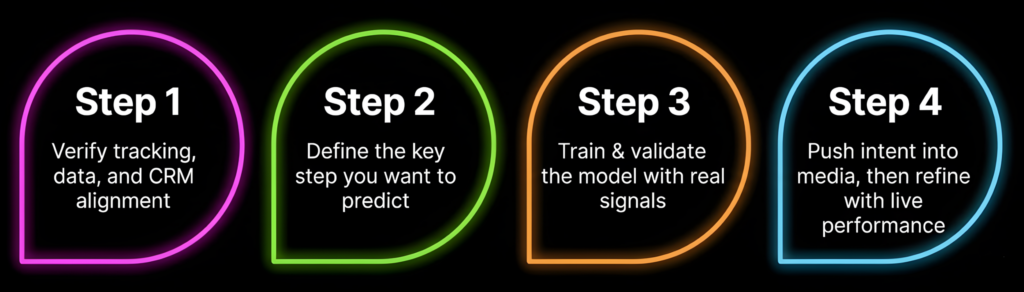
Level.Signal uses machine learning to analyze historical behavioral, lead, and media data and identify which combinations of signals correlate with downstream conversions, not just form fills. It is trained on your actual funnel, so the data points it weights are the ones that have proven predictive in your specific context.
How have higher education brands used Level.Signal?
Higher education is one of the hardest verticals to measure accurately, with long consideration cycles, multiple touchpoints, and conversion events that lag media activity by weeks or months. For one higher education client, Level.Signal identified which behavioral and media signals predicted enrollment intent, redirected spend accordingly, and delivered a 48% increase in applications alongside a 30% reduction in cost per application.